
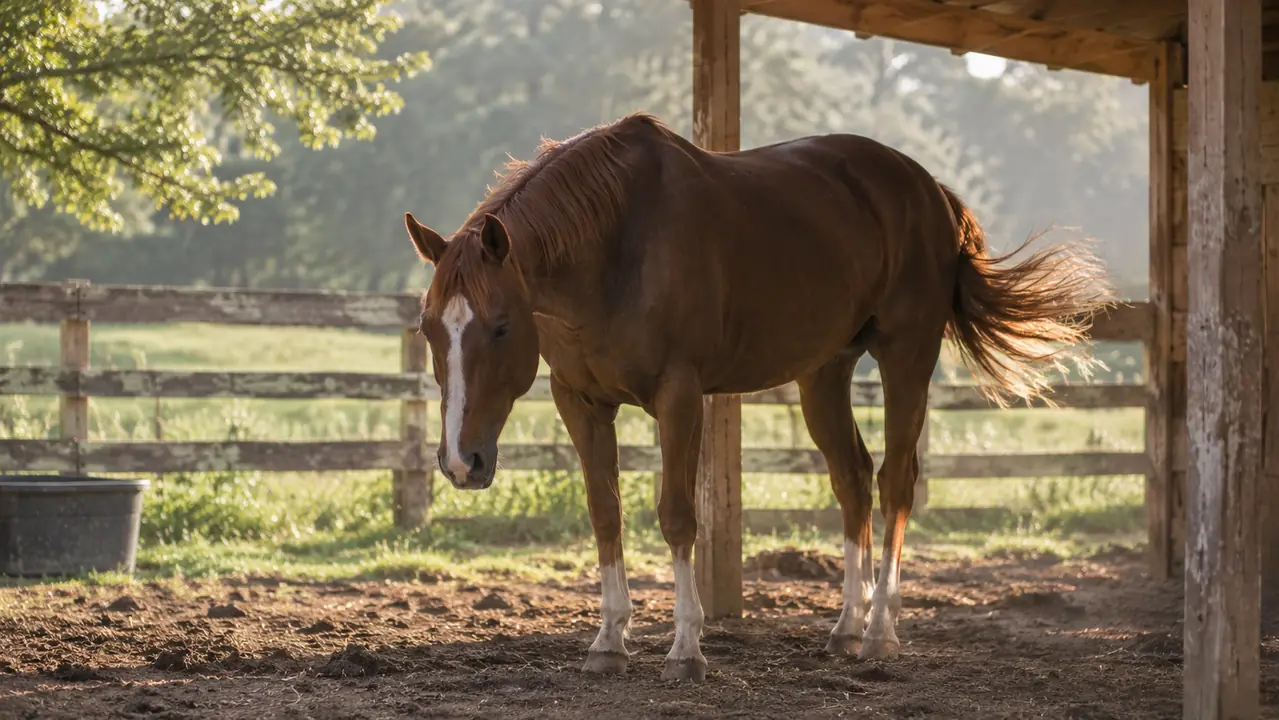
The first week of July, Dusty stood in the shade of the run-in shed with his tail going like a metronome and would not walk out to the pasture. Not lame. Not off his feed. Flies. Western New York hands us a wet spring and then a run of humid eighty-degree days, and the biting flies come up off the creek bottom behind my barn in numbers that make a horse miserable. I had already been through the wipes, the homemade vinegar mix, and a drugstore spray that lasted about as long as it took me to walk back to the house. That was the summer I started using Absorbine UltraShield EX on him and started writing down what happened.
I keep one horse, so I am picky about what goes on him. Dusty is a 14-year-old sorrel Quarter Horse gelding, about 15.1 hands, steady as a rock on the trail and a little barn-sour, which means he would rather stand at the gate than go anywhere. He is also girthy. If a pad or a cinch is not sitting right he tells me before I get my foot in the stirrup, and he is not shy about it. A horse like that teaches you to notice whether a product bothers him. Fly spray is right up at the top of that list. Something that stings or reeks will have him dancing on the cross ties, and then I have wasted a bottle and an afternoon.
The Quick Verdict
The first fly spray I have bought twice. Real coverage on a sweating trail horse, and Dusty does not fight the sprayer.
Amazon Check Today's Price →The one bottle that stayed in my tack room for a second season
Absorbine UltraShield EX, 32 fluid ounce sprayer. Kills and repels 70+ species, labeled for up to 17 days with UltraBond Technology. Water-based, with sunscreens and coat conditioners built into the formula.
Amazon Check Today's Price on Amazon →How I've Used It
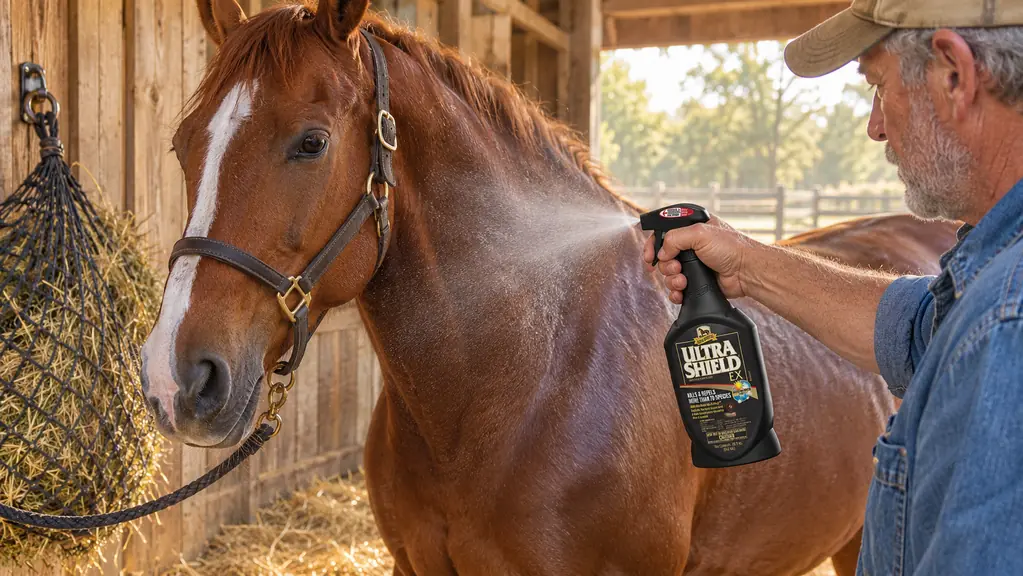
I do not bathe him in it. I spray. Dusty gets a light pass over the neck, shoulders, chest and barrel, then down the legs, then a second pass under the belly and along the flank where the biting flies like to sit. I do it on the cross ties with a hay net in front of him, which is the only arrangement I have found that keeps his head still. Then I wipe my hands on a rag and go on with tacking up. The whole thing takes about three minutes once you find a rhythm, and that matters at six in the morning when I want to be on the trail before the heat settles in.
The first time I used it I made a beginner's mistake and held the bottle about six inches off his shoulder, which soaked one patch until it ran and left the rest of him dry. Now I hold it closer to a foot away and keep my hand moving, and I work from the shoulder back instead of starting at the hip. Dusty flinches at the sound of a new bottle, so I shake it a few times near his shoulder before I ever pull the trigger. Two summers of that and he does not lift his head anymore. If your horse is jumpy, that little warm-up is worth more than any claim printed on the label.
The bottle I buy is the 32 fluid ounce sprayer, and it went further than I expected. I am spraying one 15.1-hand horse three or four times a week through the worst of the season, plus a little on the barn, and I did not run out before the flies tapered off in September. For a one-horse barn, that is the difference between one bottle a summer and three.
I also use it on the barn and on the dog. The label lists it for horses, ponies, dogs, barns, or on premise, so I have sprayed the door frames and the shaded corner of the run-in where flies gather in a knot. Biscuit, my Australian Shepherd mix, gets a light mist on his back before we walk out to the mailbox, mostly because the deer flies out here do not care whether the animal has two legs or four.
What the 17-Day Label Really Feels Like
The label says protection up to 17 days with UltraBond Technology, and I want to be straight with you about that number, because a horse is not a fence post. I have never gotten seventeen days on an animal that is sweating. What I get in July, on a horse that trailers to a trailhead and works up a lather on the hills, is closer to five or six days of solid cover before I notice him getting twitchy again. That is still the best I have found by a wide margin. The spray I used before this was good for a day, maybe a day and a half, and then he was stomping.
Take the second Saturday in August, the kind of day this part of the state does well. We hauled over to the state forest, unloaded at the trailhead around seven, and put in about nine miles along the ridges and back through the creek bottom. By the time we reached the trailer Dusty was lathered across the chest and halfway down his neck, and that sweat had taken most of the spray with it. That is the honest test, not a horse standing in a paddock. I resprayed at the trailer before we drove home and did not have to touch him again until Tuesday. Five days of cover, two of them hard work days.
Where the long window really shows up is on the days he stays home. If I spray him Sunday and he stands in the pasture all week, I can still see flies bothering him less on Wednesday than they bother the horses in the next field over. Sun and sweat wear it down, not time. So I plan around that. A show week or a weekend of trailering and I respray more often. A quiet week at home and I stretch it out and he is fine.
The other thing a longer window changes is the morning routine. Before, I was spraying every single day whether I rode or not, because skipping a day meant a horse stomping in the pasture by noon. Now it runs on a rotation. That gave me back a piece of every morning, and honestly that is worth more to me than the bottle itself.
I have never gotten seventeen days on a horse that is sweating. Five or six days of real cover on a working trail horse is what this delivers, and that is still the best I have found.
What's Actually in It
The active ingredient listed is pyrethrins, and the formula is water-based rather than solvent heavy. That matters to me for one plain reason: a water-based spray does not leave a sharp chemical smell hanging in the barn aisle. The label lists the scent as unscented. I would not call it completely odorless, but it does not announce itself, and Dusty does not throw his head up when I come at him with the sprayer. For a horse that has opinions, that is half the battle.
It also carries sunscreens and coat conditioners, which sounds like something off a shampoo bottle until you own a sorrel that bleaches out every August. Dusty's coat held its color better through this summer than it did when I was using a plain repellent and nothing else. I cannot prove the sunscreen is doing it. I can tell you his coat is not fried and the hair under his mane is not brittle, and I will take that.
Gnats are the ones that send him running. There is a low wet corner down by the creek where they come up in a cloud around dusk, and a horse walking through that will shake his head and root at his own chest trying to get away from them. I sprayed the shaded corner of the run-in and the door frames the first week, then again two weeks later, and the difference in how he stands in the evening showed up inside a couple of days. Ants are on that same label, and I get a line of them along the tack room threshold every June, so the bottle does double duty there too.
The label also covers 70+ species: flies, mosquitoes, ticks, gnats, ants and more. Ticks matter to me more than most people talk about. We have plenty of them in the brush along the state forest trails, and a horse picking up ticks is a vet bill waiting to happen. I still do a hands-on check after every ride, because no spray replaces that, but I have been finding far fewer on him since I switched.
What I Liked
- Held five to six days on a sweating trail horse, far longer than the one-day sprays I used before
- Water-based and light on smell, so a horse with opinions does not fight the sprayer
- Sunscreens and coat conditioners built in kept a sorrel from bleaching out by August
- One 32 fluid ounce sprayer lasted most of a fly season on a single horse
- Labeled for horses, ponies, dogs, barns and premises, so one bottle covers the whole place
- Consistently voted The Chronicle of the Horse Reader's Choice for favorite fly spray
Where It Falls Short
- The 17-day claim does not survive heavy sweat, so plan on five or six days in July
- You still have to hand-check for ticks after brushy rides
- It is a spray, not a wipe, and a horse that hates the sound needs a slow introduction
- It will not fix a barn with standing water and piled manure, and you still have to clean
Where It Comes Up Short
The honest limitation is sweat. If you are riding hard in humid weather, this is a five-to-six-day product, not a seventeen-day product, and I would rather tell you that than have you find out on a Saturday. I respray before any long trailer haul and before a weekend of back-to-back rides. In the middle of August I will sometimes do a midweek touch-up on his belly and legs only, which stretches the bottle and keeps him comfortable without soaking him again.
The other gap is the face. I am not spraying a horse in the face with anything, so his muzzle and the area around his ears and eyes get handled with a fly mask and a rag, not this. Practically that means a mask that fits and a rag with a little spray worked into it for the parts he will let me touch. Dusty will stand for a mask, which is more than I can say for some horses I have known. The rag works on the muzzle if you keep it light and stay out of his nostrils. Around the eyes I use nothing but the mask, and I would tell you the same thing standing in my barn aisle. None of that is a knock on this bottle. The job just has more than one part, and the spray only does one of them.
And if your barn has standing water in the wheelbarrow or manure piled behind the shed, no spray on earth will save you. I clean the run-in twice a week in fly season, and it makes more difference than any bottle. When I got behind on it in June, one week of slack, the flies came back in a way that spraying could not keep up with. The spray buys you comfort. It does not buy you a clean barn.
Fitting It Into a Whole Season
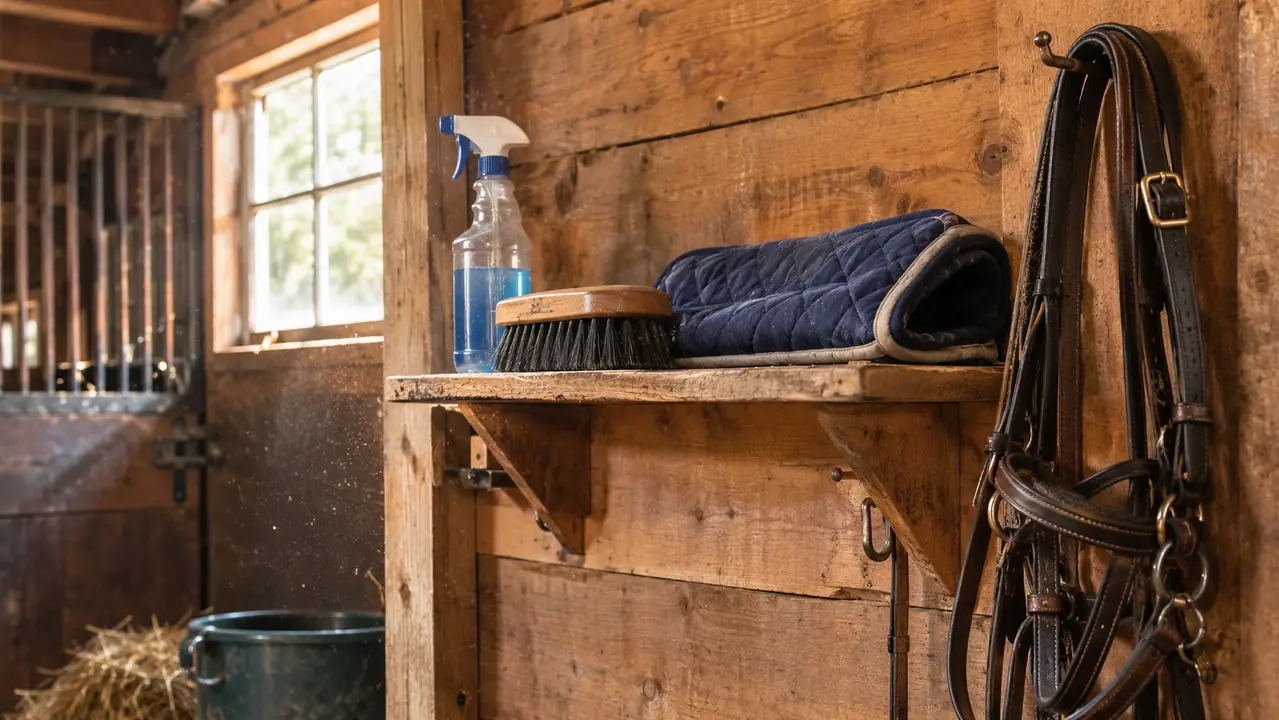
My routine by mid-June looks like this. Sunday, full spray on the cross ties. Wednesday, quick pass on the belly and legs if he has been out on the pasture. Friday before a trail ride, full spray again because I know he will sweat. Barn door frames and the shaded corner get hit every couple of weeks. The bottle lives on the shelf in the tack room I built myself, out of direct sun, and I keep the cap on it, because I have ruined a sprayer or two by leaving it where the nozzle clogs with dust.
If you are weighing this against another brand, the number to compare is not what the label promises. It is how long each one holds up on a horse that is working and sweating. Ask a neighbor who trail rides. Ask what their horse looks like on day four. That question has saved me more money than any review ever has, and it is the reason this one stayed in my tack room for a second season.
Who This Is For
This is for the person with one or two horses who rides out on real trails in real humidity and is tired of spraying every single morning. It suits a horse that stands for the sprayer, or a horse you are willing to teach. It suits a small place where the same bottle can do the horse, the barn door and the dog, because that is genuinely how I use it. And it suits anyone who has watched a sorrel bleach out by August and would like that to stop.
Who Should Skip It
Skip it if your horse truly will not tolerate a sprayer and you have no intention of working on that. Skip it if you need something for the face, because this is not that and you should not be spraying a muzzle anyway. Skip it if you are going to read the 17-day line as a guarantee on a hard-working horse, because in my experience it is not one. And if you are running a big herd, work out what it costs you per head per month before you commit, because a single bottle is sized for a small barn, not a boarding operation.
One bottle, one horse, one season. That is the whole test.
Absorbine UltraShield EX in the 32 fluid ounce sprayer. Kills and repels 70+ species, water-based, with UltraBond Technology behind the long protection window. If your horse sweats, plan on respraying more often than the label says. It still beats everything else on my shelf.
Amazon Check Today's Price on Amazon →