

The woman at the feed store told me Absorbine UltraShield EX was the only spray that held up through black fly season, and I bought a bottle on her word alone. That is not a careful way to choose anything. I had already gone through two cheaper sprays that spring, and both of them quit working somewhere around the moment my gelding started to sweat. Dusty is a 14-year-old sorrel Quarter Horse, about 15.1 hands, and he sweats like it is his job. A spray that only works on a dry horse in cool weather is a spray I cannot use, no matter what the shelf tag says.
So this is the honest version of the review, the one I would want if I were standing in the aisle trying to decide. Absorbine UltraShield EX lasts longer on my horse than anything else I have tried in western New York. It also does not deliver the full 17 days the label promises, not on a horse that lives out and sweats, and there are a few small things about the bottle nobody mentions at the register. I will take both halves of that in order.
The Quick Verdict
The longest window between sprayings of anything on my shelf, with a 17-day label that is really a best case. Plan on reapplying every five to seven days on the body and sooner on the face, and you will be glad you bought it.
Amazon Check Today's Price →The 32 oz Sprayer I Buy Before the Flies Get Bad
Same bottle, same trigger, same label. If you want to weigh it against whatever is already on your shelf, today's price is the place to start.
Amazon Check Today's Price on Amazon →What Nobody Tells You About the 17-Day Number
The label on Absorbine UltraShield EX says protection up to 17 days with UltraBond Technology, and the listing adds that it is built for the most challenging conditions. That number is real. It is also measured under conditions I have never once managed to reproduce in my own barn, and I suspect you will not either.
Here is what 17 days looks like in practice for me. I sprayed him on a Saturday morning in the middle of June, a dry week with the temperature in the low eighties, and I wrote the date on the calendar by the tack room door. The first three or four days, the spray does everything it claims. Flies come near the horse and then think better of it, and I rode a two-hour loop that Tuesday without a single deer fly settling on him. By day six or seven, the back and the hindquarters still hold, but the face, the ears and the soft skin under the jaw have gone back to being a fly buffet. By day ten, which was the following Monday, I could find flies standing on his shoulder out in the pasture. The spray has not failed exactly. It has simply worn off where the horse rubs and where the sweat runs.
Rain is the bigger variable. A dry week in June gets me close to the 17 days. A wet week cuts that roughly in half, and no spray on the market is going to argue with a horse standing in a downpour. Dew counts too. We get heavy morning dew here from May through September, and a horse turned out overnight loses some protection across the back by the time I bring him in for feed.
To be fair to the label, I have never run a controlled test. What I have is several seasons of the same routine on the same horse in the same corner of the state, and a notebook where I write the date I sprayed and the first date I saw flies landing again. The entries are not impressive to look at. July 12, sprayed at seven in the morning, first flies on the shoulder on July 19. June 2, sprayed before turnout, flies back on the face by June 6. That notebook is not science. It is just the only honest way I know to answer the question people are really asking when they pick up the bottle, which is whether it lasts all day or a good deal longer than that.
So how much of the claim should you trust? Treat 17 days as the ceiling, not the schedule. On my horse, in my weather, I reapply every five to seven days on the body and every two to three days on the face and ears, and I get a result I am happy with. If I stretched it to a full 17 days across every part of him, I would be disappointed, and I would be blaming the bottle for a number I read wrong.
How I Actually Use It on the Trail
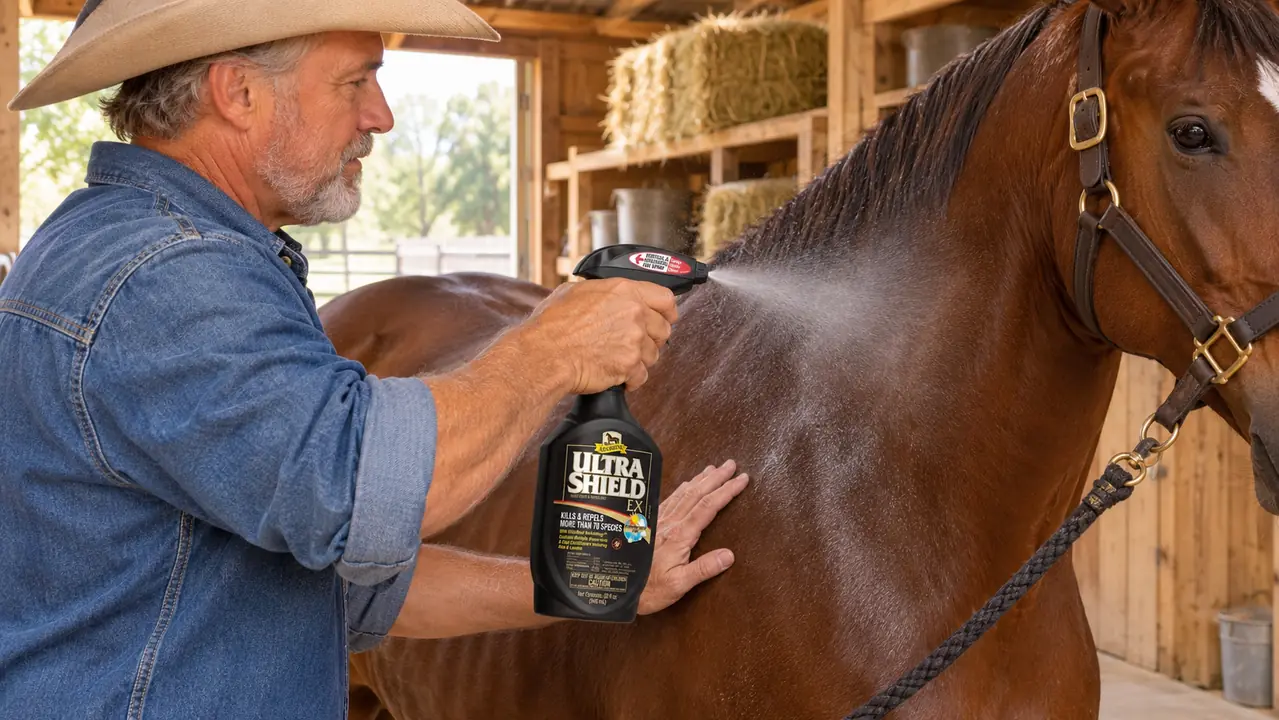
My routine is not complicated, but the order matters. I curry Dusty first, because a spray laid over loose dirt and shedding hair is money on the ground. Then I spray the body against the direction of the hair, starting at the shoulder and working back, holding the bottle about eight inches off the coat so it goes on as a mist instead of a soaking.
The face is where people get into trouble, and it is where I stopped being lazy about it. I spray a rag, not the horse, and wipe the rag over the forehead, around both ears and under the jaw, keeping it well clear of his eyes. I do this in the aisle with his head in my hands and both of us calm. Every summer I hear about a horse that got a face full of spray because somebody was in a hurry, and I would rather spend the extra minute.
I keep a folded rag in the tack room for exactly this job, and I wash it out every couple of weeks so I am not wiping his face with something stiff and crusty. When the bottle is new and full, the rag gets damp and stays damp long enough to do the forehead, both ears and the jaw without re-wetting. That is the whole method. There is no trick to it.
Timing matters as much as technique. I spray before I load, not after. That gives the coat time to dry on the trailer ride over to the state forest, and it means the spray is already on him when we unload where the deer flies are waiting. Last July we pulled into the trailhead a little before nine, and the flies were already working the gravel lot where everybody tacks up. Dusty had been sprayed at the barn at seven, and he stood there for the fifteen minutes it took me to cinch up and fill a water bottle without more than one fly landing on him. I also hit the chest, the belly and the inside of the hind legs, which are the spots a horse cannot swat and the spots flies seem to find first.
One more thing that took me a while to learn. Do not spray a tied horse next to an open bale of hay or a feed bucket. The mist travels, and I have watched a barn mate pick up a mouthful of hay that tasted like the aisle floor. Take the horse outside or to the middle of the aisle and be done with it.
Where It Holds Up and Where It Does Not
Deer flies and horse flies are the reason I keep buying Absorbine UltraShield EX. Those big slow flies that circle a horse on a July trail ride are what turn a good ride sour. On the back roads and forest trails we ride, the spray keeps most of them off for the first half of a ride, and the ones that do land tend to land and leave rather than stay and bite.
Ticks are the other reason, and this is the part I did not care about ten years ago and care about a great deal now. Western New York is tick country, and a horse on rough pasture picks them up. I am not going to tell you a spray replaces a tick check with your fingers, because it does not. What I will tell you is that I find fewer on him in the seasons I am consistent with this bottle than in the seasons I am not.
Gnats at dusk are a coin flip. The spray helps, and the label lists gnats among the 70-plus insects it handles, but a horse standing in the corner of a pasture at 8 p.m. with gnats rising off wet grass is going to get gnats. Nothing I have ever poured out of a bottle has changed that, and I have tried a fair few.
The cheaper bottles I used before this one were not terrible on the first day. I started one spring with a citronella spray a friend swore by, and it did fine right up until the horse sweated through it, which on a July afternoon took about forty minutes. By the second week I was re-spraying at the halfway point of every ride and still swatting flies off his neck. The difference shows up on day three, when the cheap spray has quit and this one has not, and it shows up again out on the trail in fly weather when I am not carrying a second bottle in my saddlebag. I would rather buy one bottle I trust than three I am constantly re-spraying.
What it will not do is fix a management problem. If your horse stands in a dirty run all day, or your barn has wet hay stacked against the wall, no spray keeps the flies off him. The label does allow for use on barns and premises, and I have misted the walls of my two-stall barn with it in a bad August, but I think of that as a small extra and not the reason to buy.
On a hot July ride through the state forest, Dusty came home with flies on his ears and none on his back. That is about as much as a bottle can do.

The Sprayer, the Bottle and the Small Annoyances
The bottle is a 32 fluid ounce sprayer, 2.2 pounds full, and about 4 by 4 by 10 inches, which means it stands square on a shelf and does not tip every time I reach past it. I built the shelves in my tack room myself and they are not generous, so a bottle that stays where I set it down is worth something to me.
The trigger is the annoyance. Doing a whole 15.1-hand horse is a couple of minutes of steady squeezing, and by the time I reach the hindquarters my hand is tired. If I am also spraying a friend's horse before we haul out, I feel it the next morning. The last time I did two horses back to back before a fun show, I counted out of curiosity, and it was somewhere north of a hundred and forty pulls on that trigger between them. That is the reality of a trigger sprayer this size more than any knock on this one, but you should know it going in.
The listing calls the scent name unscented, and I would describe it as faint. There is a smell when it goes on, it hangs in the aisle for a minute, and then it is gone. I mention it only because I have used sprays that left a horse smelling like a citronella candle for a week, and this is not one of them. His coat looks decent once it dries, which I credit to the sunscreens and coat conditioners in the water-based formula, though I would not buy a fly spray for the shine.
The last small thing is the mist. On a breezy day a good share of what you spray goes sideways. That is true of every spray ever made, but at 32 ounces a bottle it stings a little when half of it ends up on the barn floor. I spray in the aisle with the door shut, or outside on a calm morning, and more of it lands where I want it.
One bottle carries me most of the way through a season on one horse. That is my number, not a promise to you, and it depends on how wet the summer runs and how many times I hand the bottle to whoever is at the barn that day. I write the date I open it on the bottom with a marker, mostly so I stop wondering whether the bottle on the shelf is this year's or last year's.
What I Liked
- The longest gap between applications of anything I have used, close to the 17-day label in a dry week
- Handles deer flies and horse flies on trail rides, and I find fewer ticks when I stay consistent
- Water-based formula with sunscreens and coat conditioners, and the coat is not greasy after it dries
- The 32 ounce bottle stands square on a tack room shelf and carries me most of a season
- Label covers horses, ponies, dogs, barns and premises, so one bottle does several jobs
Where It Falls Short
- The 17-day number is a ceiling, not a schedule, and the face and ears need attention every few days
- Rain, heavy dew and a sweating horse shorten the window noticeably
- The trigger tires the hand by the time you finish a full-sized horse
- Mist drifts in any breeze and you lose product
- Flies on the face come back fast no matter what you spray
Who This Is For
This is for the rider who keeps a horse at home or on a small boarding barn and wants one bottle doing the heavy lifting from May through September. If you ride trails where deer flies and horse flies are a genuine problem, if you are in tick country, and if you would rather spray once a week than once a day, Absorbine UltraShield EX earns its shelf space. It suits a horse that sweats, a horse that lives out, and an owner who does not want to think about flies again until the bottle runs low.
Who Should Skip It
Skip it if you want a spray you can put on once and forget for two and a half weeks, because that is not what this is, and you will feel cheated by day eight. Skip it if your horse has ever reacted to pyrethrins, which is the active ingredient on this label. Skip it if you want something you can slap on a horse that is already lathered and dancing, because you still have to get the application right for any of it to work. And if all you need is something for a quiet pony in a shaded paddock, a smaller and plainer spray will do that job without the extra cost.
If You Only Buy One Fly Spray This Season, Make It the One Still Working on Day Seven
It will not stretch to 17 days on a sweating trail horse in wet weather. It will still be going when the cheaper bottles have quit, and that is the whole argument.
Amazon Check Today's Price on the 32 oz Sprayer →