
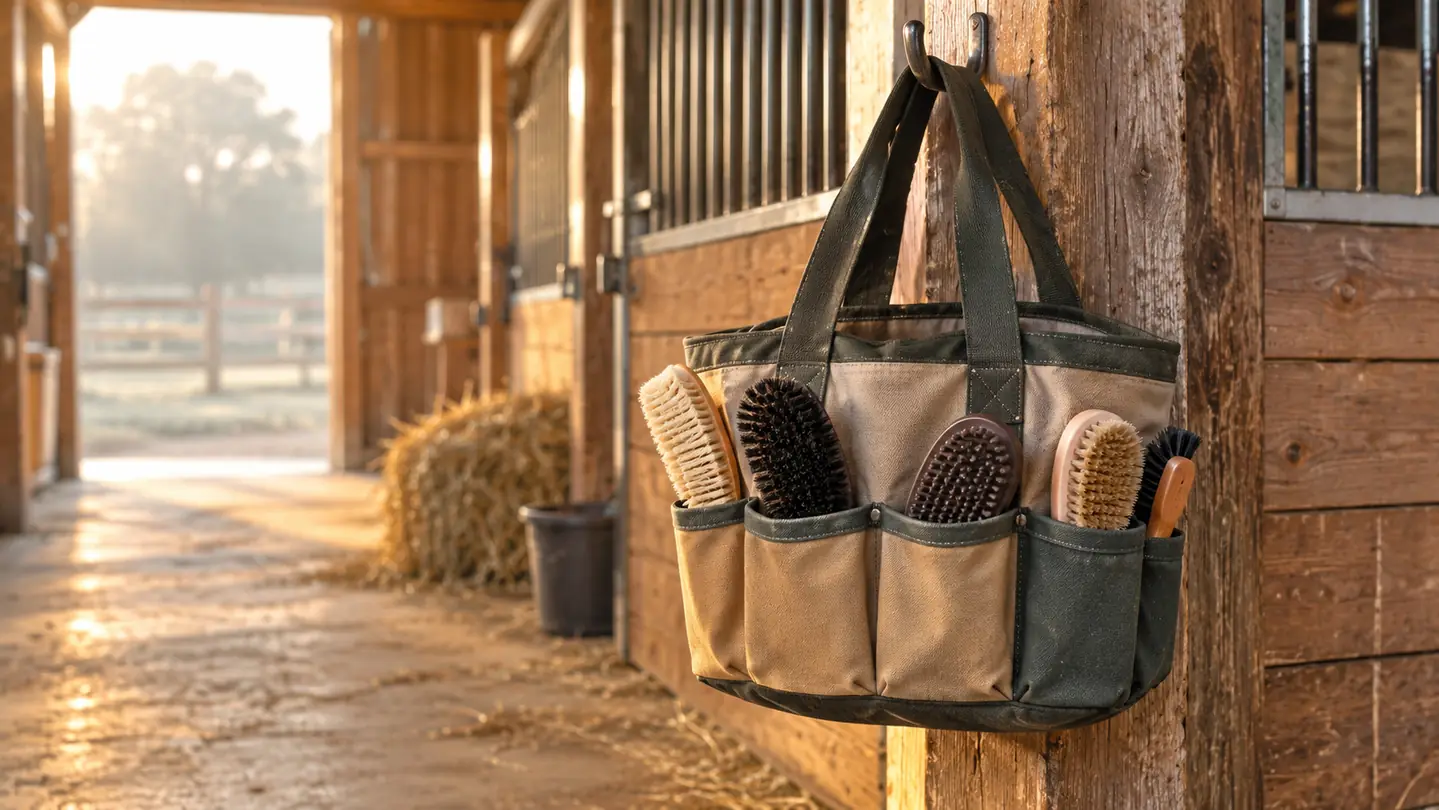
My tack room has one shelf that used to be a wreck. Brushes lying on their sides, a hoof pick buried under a bag of treats, a comb missing half its teeth, and nothing in the same spot two mornings running. I groom Dusty every day, not just before a ride, so I was digging through that pile twice a day for years. The Weaver Equine 7-Piece Grooming Kit is what finally ended it. Not because the tools do anything fancy. Because seven pieces, one tote with six outer pockets, and a single place to hang the whole works means I quit losing things I need.
I have been riding since I was a girl and I have owned more cheap brushes than I can count. Most of them end up the same way, bristles splayed, handles cracked, the set scattered from the tack room to the trailer to a bucket by the wash rack. Dusty is a 14-year-old sorrel Quarter Horse gelding, about 15.1 hands, steady as a rock on the trail and a little barn-sour when we turn for home. He gets groomed before and after every ride, whether we are going down the road or loading into the two-horse bumper-pull for a state forest trail. This kit has been the set I reach for since it landed in the tack room, and it has been through months of that routine now.
The Quick Verdict
Solid tools in a bag that fixes the actual problem, which is that brushes wander off and never come back. Months of twice-daily use and nothing has broken. The tote is the reason to buy it.
Amazon Check Today's Price →The hoof pick has a pocket now. That alone changed my mornings.
Seven pieces, six outer pockets, webbing handles that hang flat against a trailer wall. Mine lives on a hook by the barn door and has for months.
Amazon Check Today's Price on Amazon →How I've Used It
My routine is not complicated. Dusty comes out of his stall, gets cross-tied in the aisle, and gets brushed off before the saddle goes on. After a ride the sweat gets scraped and the saddle area wiped down before he goes back out. Twice a day, seven days a week, for years. What changed with this kit is that everything for that routine lives in one bag hanging on a hook by the barn door. I pull it down, work through it, hang it back up. No hunting, no walking back to the tack room because I set the hoof pick down somewhere again.
There was a Tuesday in April that sums up what this bag is good for. Dusty came in from the back pasture with mud packed into both front hooves and a mane full of burrs. I hung the Weaver tote on the gate, picked both hooves, worked the burrs out with the comb, and brushed him down, and every tool I needed came out of a pocket and went straight back into one. Twenty minutes, maybe. With the old pile on the shelf I would have made two trips to the tack room and still set the hoof pick down in the mud.
On weekends we load up and go. The tote rides in the trailer and hangs from a tie when we get where we are going. That sounds like a small thing until you have chased a loose brush across the floor of a moving trailer or dug one out from under a bale of hay. The webbing handles take the weight fine and the bag hangs flat against the trailer wall instead of swinging out where a horse can bump it. Loaded up it weighs under three pounds, so carrying it from the barn out to the wash rack is not a chore either.
It has been through mud season, which in western New York means a horse that comes in wearing half the pasture. It has been through the dry stretch in July when the dust comes off a coat in a cloud and everything in the barn is grey by noon. Now we are into blanket weather and it is the same set, same pockets, same hook. I have not had to replace a single piece, and I have not had to go looking for one.
What's Actually in the Bag
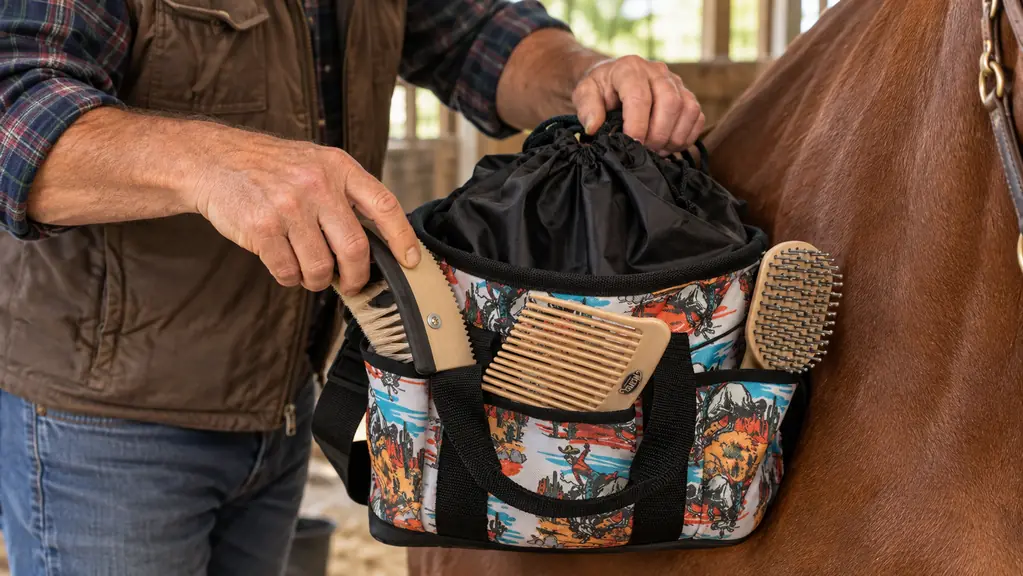
You get seven pieces. That is a hoof pick, a comb, a sweat scraper, and several brushes, all with plastic handles, plus the tote itself. The whole kit is listed at 2.8 pounds, light enough that I do not think about it on the walk out to the pasture and light enough that a kid could carry it without complaint. Mine is the Bucking Bronc version. It hangs on a hook or sits on a shelf, and it takes up less room than the pile of loose brushes it replaced.
The Weaver tote is listed at 11 by 7 by 11 inches, which is small enough to sit on the shelf I built into my tack room wall without hanging off the edge. The six outer pockets run around the outside, deep enough that a brush handle stands upright in them and shallow enough that you can get a hand in without digging around. The pieces that do not fit a pocket go down in the middle, and the outside of the bag has enough shape to it that it does not fold over on itself when it is half empty.
The hoof pick is the piece I use most, twice a day, every day, and it is also the piece I have snapped on other kits. This one has a handle with enough body to it that I can get real pressure behind the tip without the whole thing flexing. The comb gets used on mane and forelock, and it does that job without pulling. The sweat scraper comes out after every ride and has held up to a wet back and a firm hand.
The brushes are the part I was most skeptical about, because kit brushes are usually the weak link. These are decent. Not the nicest brush I own, but perfectly serviceable for knocking off overnight dirt and getting mud off a shoulder before a ride. If your horse comes in a mud ball in the spring, the brushes here will get you started, but the heavy shed is still a job for whatever curry you already own. That is true of most kits and it is true of this one.
The Tote Does the Heavy Lifting
Six outer pockets is the number that matters. The hoof pick goes in one, the comb in another, the sweat scraper in a third, and the brushes stand up in the rest. After about two weeks I stopped thinking about where anything was, because it was always in the same pocket it had been in the day before. That is a small thing that adds up to a real difference when you are standing in a cold aisle at six in the morning with a horse that wants his breakfast.
The bag itself is plain and sturdy. Nylon, webbing handles, a rectangular shape that sits flat, nothing complicated about it. It hoses out. Dirt and shavings do collect in the bottom of the tote and down inside the pockets, which is what happens when a fabric bag lives in a barn, and every couple of weeks I dump it out, rinse it, and hang it back up to dry. That is a two-minute job and I would rather do it than own a bag I cannot get wet.
How It's Held Up Over Months
The stitching on the handles is intact and the webbing has not frayed. That is the failure point on cheap totes and it is the first thing I check. The plastic handles on the tools have no cracks in them, even after being dropped on a concrete aisle more times than I want to admit. The brushes have lost a little shape in the bristles the way all brushes do, but none have splayed out sideways or started shedding into the coat while I am using them.
I kept track of it about the way I keep track of anything in a barn, which is to say badly. What I can tell you is that it has been through a full summer of dust, a fall of rain and mud, and the first six weeks of blanket weather without a single repair. It has ridden in the trailer for a dozen trips to the state forest and twice that many short hauls to the fairgrounds, and the handles have not pulled loose from the bag once. That is the test I care about most.
The honest answer on what broke is nothing. What wore is more useful to talk about. The bristles on the brush I reach for most have softened, which is normal and honestly more comfortable for the horse than when it was new. The bag has faded some, which affects nothing at all. The comb has a couple of teeth that have bent, because I have used it on a thick tail it was never really meant for. That one is on me, not on the kit.
Six outer pockets means the hoof pick, the comb and the scraper each have a home, and I have not misplaced one of them in months of daily use.
What I Liked
- Seven pieces plus a tote with six outer pockets, so nothing gets lost or left on a shelf
- Webbing handles and under three pounds loaded, easy to carry and easy to hang flat
- Hoof pick has a handle stiff enough to take real pressure without flexing
- Stitching and handles have held up through months of twice-daily use
- Hoses out and rinses clean, with no moving parts to jam or snap
Where It Falls Short
- Fabric bag collects dust and shavings in the bottom and needs emptying regularly
- Brushes are solid but not the best I have used on a heavy spring coat
- Comb snags on a thick tail if you push it
- Sweat scraper is on the stiff side and takes a firm hand around the legs
- Nothing here replaces the curry you already own for shedding season
What I Compared It To
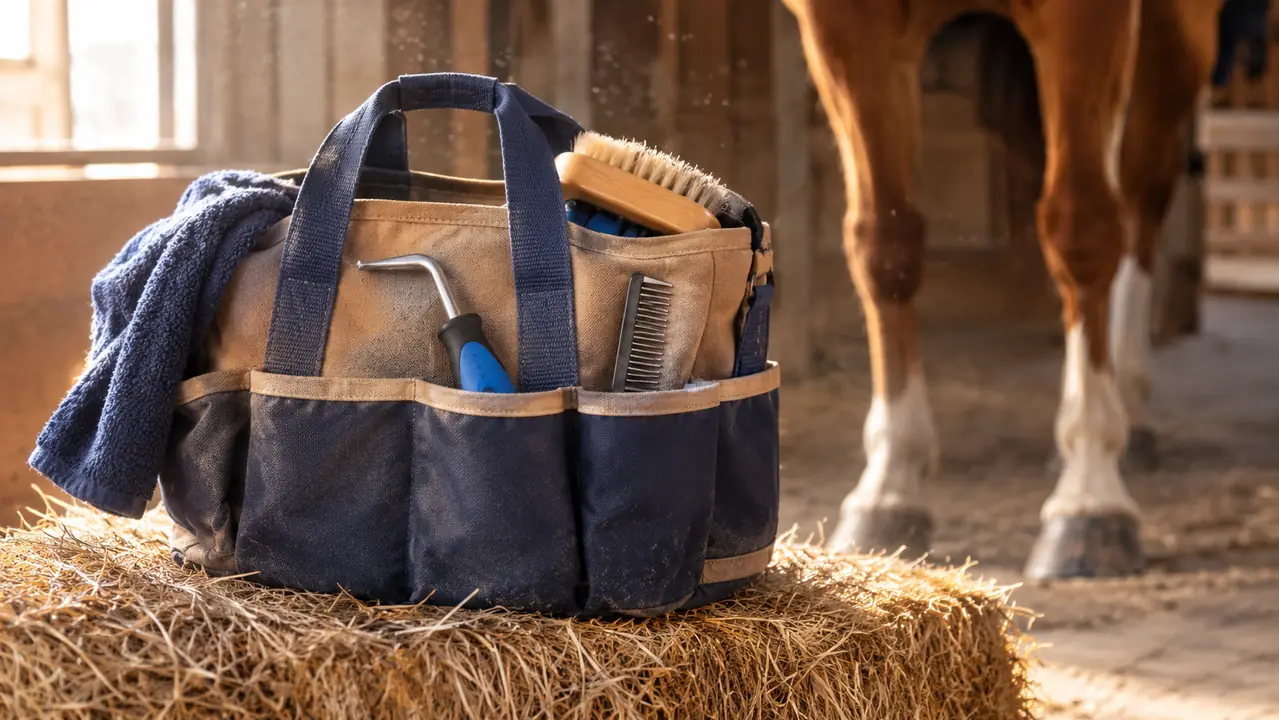
Before this I had a brush roll I liked and a bucket of loose brushes I did not. The roll was fine right up until it got wet, and then it stayed damp and started to smell like a horse blanket that never dried out. The bucket collected dirt, rain, and whatever fell off the shelf above it. What I wanted was something I could hose out and hang up, with pockets that told me where things belonged so I did not have to remember. That is exactly what the Weaver tote is, and it is why I quit rotating between the roll and the bucket.
I also thought about just buying one better brush and keeping my old bag. I decided against it because the problem was never that I did not own a good brush. The problem was that I could not put my hand on the good brush when I needed it. If that is your situation, the bag is the upgrade, not the bristles. If you already have a bag you like and the brushes are the weak part, then buy brushes and skip this.
What I'd Change
I would like the bottom of the tote to shake clean easier, because that is where the shavings end up and they do not always come out with a rinse. I would like the comb to have slightly heavier teeth so I could take it to a tail without worrying. And I would like the brushes to be a step up in quality, because the bag they came in is honestly nicer than the brushes deserve. None of those are deal breakers. I am still using the same kit months later, which is more than I can say for the last set of loose brushes I bought.
One more thing worth saying plainly. This is a grooming kit, not a cure for a dull coat. It will not replace good feed, hay, and a horse that gets to move around. What it will do is put a hoof pick, a comb, a scraper, and brushes in one place you can carry with one hand. If your grooming is already organized and working, you do not need it. If it is a pile on a shelf, you probably do.
Who This Is For
This is for the person whose brushes live in a heap. The trail rider who grooms in the aisle and hauls on weekends and is tired of loading loose tools into the trailer. The boarder who has to carry everything from a tack locker to a cross-tie and back. The 4-H family buying a first set for a kid who will lose a hoof pick inside a week unless it has a pocket to live in. I would not call it a starter kit exactly, because the tools are a step better than most starter gear, but it is the set I would hand a kid heading to the county fair with a horse that needs to look decent and a mother who does not want to buy eleven separate things.
Who Should Skip It
If you already own good brushes and only need a hoof pick, buy the hoof pick. If your horse lives out and comes in caked every day in spring, put your money into a proper curry and a decent body brush before you buy any kit. And if you show seriously and already have a brush roll you love, this will not beat it. I would also skip it if you are the type who hangs a bag on a hook and never rinses it out, because a fabric tote in a barn needs that two minutes every couple of weeks.
One hook by the barn door, and everything you need is already on it.
Six outer pockets, webbing handles that hang flat, and a hoof pick that takes real pressure. Mine has been in daily use for months without a failure.
Amazon Check Today's Price on Amazon →