

I have watched grown adults ride into a warm-up ring with a helmet pushed so far back on their head that the front edge sat behind the hairline. I did it myself for years. The helmet was on, so I counted it as handled. It took one close call on a gravel road, a horse that shied at a plastic bag, and a helmet that shifted halfway around my head when I ducked, to make me rethink the whole thing.
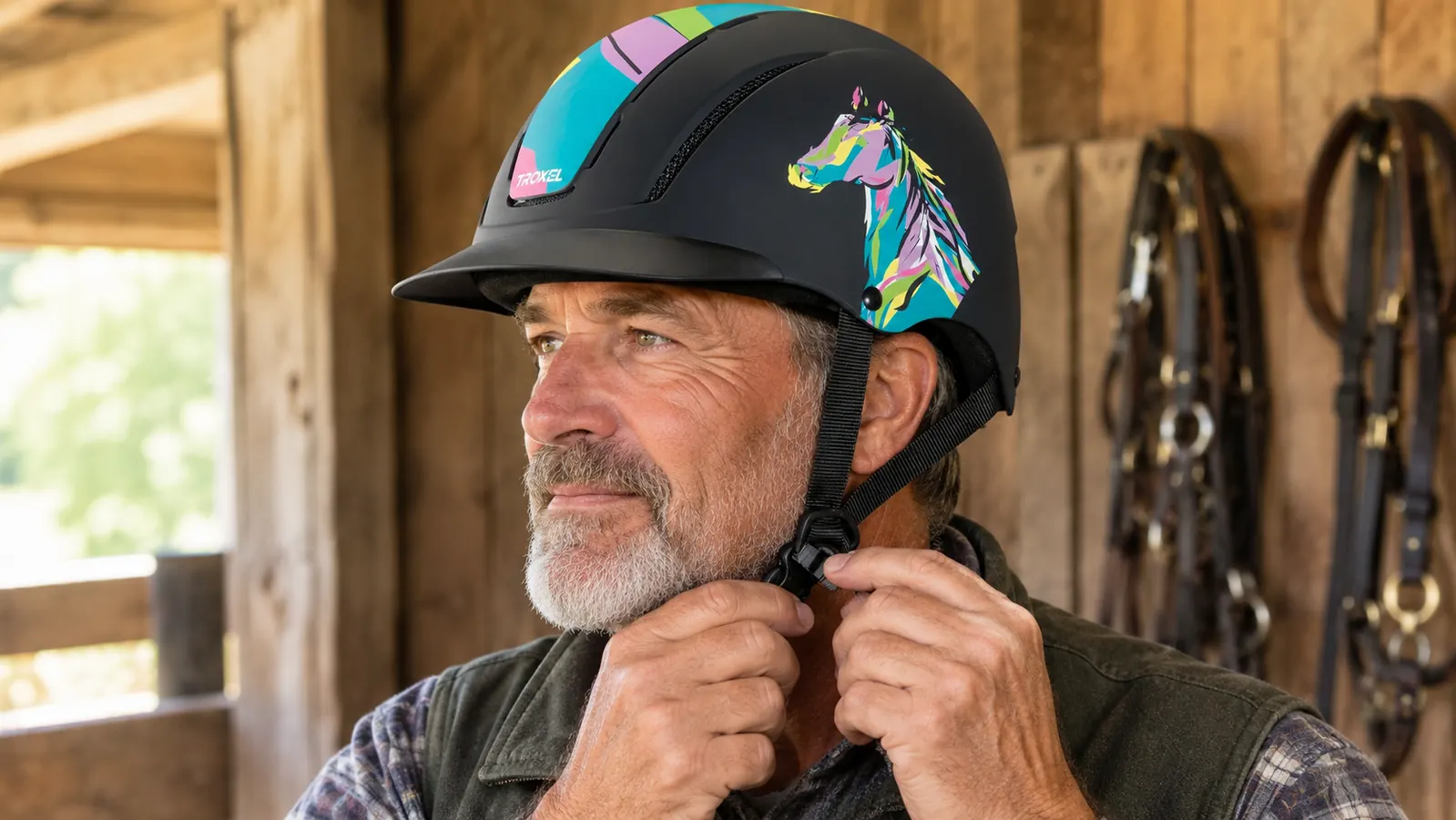
Helmet fit is not a number on a box. It is whether the helmet stays where you put it when your head moves, whether it sits level over your brow, and whether the strap under your chin actually holds it down. The Troxel Spirit is the helmet I ride in now, on a 14-year-old Quarter Horse gelding named Dusty, on back roads and state forest trails here in western New York. The Spirit is a low-profile shell with a polycarbonate outer and an expanded polystyrene liner, about 0.76 kg, with a visor and airflow vents across the top. The shell is only half the job. The other half is the five steps below, and they take about ten minutes the first time.
Get It Fitted Once and Stop Thinking About It
The Troxel Spirit is the everyday helmet that lives by my tack room door. Measure your head first, then check sizing and today's price on Amazon.
Amazon Check Today's Price on Amazon →Why Fit Comes Before the Helmet Itself
A helmet works by staying put. The polycarbonate shell spreads the force of a hit over a wider area and the polystyrene liner crushes slowly to soak up the energy. Neither of those things happens if the helmet rotates or lifts before your head stops moving. That is the whole argument for fit, and it is why I am fussy about this in a way I never used to be.
The second reason is comfort. A helmet that pinches your forehead or rides down over your eyes gets taken off halfway through a ride. One that lifts and settles on every trot gets unbuckled at the gate. Any helmet you stop wearing is worse than the one you keep on, and that is a fit outcome, not a feature list. Mine has been comfortable enough that I forget about it before I reach the end of the driveway.
The Spirit has a polycarbonate shell over a polystyrene liner, and neither one does a thing if the helmet rotates before your head stops moving.
Step 1: Measure Your Head Before You Order
Get a cloth tape measure, the soft kind that lives in a sewing kit. A metal tape from the shop will lie to you because it will not follow the curve of your skull. Stand in front of a mirror if you can, or rope somebody into helping.
Run the tape around your head about half an inch to an inch above your eyebrows, above your ears, and around the widest part at the back. Keep the tape level all the way around. It is easy to let the back drop and get a number that is too small. Write the number down in both inches and centimeters. Measure it twice. If the two numbers disagree by more than a quarter inch, measure a third time.
The listing I bought from is the Small, and the manufacturer's size chart is the thing to check before you order anything. If your measurement sits right at the edge between two sizes, do not talk yourself into the smaller one because it feels snug in the moment. Measure with your hair the way you will actually wear it, not smoothed flat for the tape. Braids, a low bun, or a thick ponytail change the number more than people expect.
Step 2: Set It Level and Look in a Mirror
Put the helmet on and look straight ahead at yourself in a mirror. The front edge should sit just above your eyebrows, roughly an inch above them. It should not be tipped back off your forehead, and it should not come down over your eyes. The visor should look level with the ground when your chin is level.
The tipped-back look is the one I see most, usually because the helmet feels tight across the forehead and pushing it back relieves the pressure. If you have to shove it back to be comfortable, the fit is wrong, not your head. Go back to the measurement. A level helmet is the only kind that covers the front of your skull, and out of the saddle that is where a fall most often lands.
If you wear glasses, put them on before you check the level. Frames that push the helmet up at the temples are a hint that the shell is sitting too high or too wide for you, and you will feel it about an hour into a ride when the pressure point shows up behind your ears.
Step 3: Test Front-to-Back and Side-to-Side
With the chin strap still loose, put both hands on the front edge of the helmet and roll it backward, like you are tipping a hat up. Watch your eyebrows in the mirror. The skin at your brow should move up with the helmet. If the helmet rolls and your skin stays put, the helmet is too big or the fit has not been set.
Then shake your head side to side, gently at first and then a little harder. The helmet should move with your scalp, not slide around on top of it. If it rocks, if it swings, if you can feel it shift against your forehead, it is loose. This is the test I run every single time I put mine on, and it takes about four seconds once it becomes a habit.
Do the same at the back. Push up on the rear edge. Any helmet that can be lifted off your head without undoing the chin strap is not fitted, whatever the size tag says. That one sentence has saved me more grief than any chart.
Step 4: Run the Chin Strap and Check the Junction
The strap goes under your chin, not on the point of your chin. Buckle it and snug it until you can fit one or two fingers under it, no more. Then open your mouth wide. You should feel the helmet pull down slightly on your forehead. If nothing happens when you open your jaw, the strap is too loose.
The two straps should meet in a V just under your ear, and that junction should sit below the ear rather than in front of it or behind it. If the V sits forward of your ear, the helmet will rock every time you turn your head. Take the helmet off, slide the junction back, and try again.
One last check. With the strap still buckled, grab the back of the helmet and try to roll it forward off your head. It should not go. If it does, tighten the strap and repeat. That test is the one that convinced me, because a helmet that rolls forward in a fall is a helmet that is not there when you land.
Step 5: Ride in It, Then Recheck After a Month
Ten minutes in the tack room is not the same as an hour on the trail. Put the helmet on, groom your horse, saddle up, and ride. Pay attention to two spots, your forehead and the bony ridge behind your ears. If either one is hot or throbbing after twenty minutes, the fit needs another look before you write it off as a helmet that does not suit you.
Come back to it after a month of regular riding. Liners settle, straps stretch a touch, and the fit you set in May is not always the fit you have in July. I check mine at the start of every season and any time I change how I wear my hair under it. Winter changes things too, because a thin beanie under the shell takes up room the helmet was using in August.
Two hard rules that are not about fit but belong here anyway. If the helmet takes a real impact, a fall, a kick, or a drop onto the barn floor from shoulder height, replace it. The polystyrene liner crushes to absorb energy and it does not un-crush. And read the warranty. Troxel lists a limited one-year warranty on this helmet, which covers defects in materials and workmanship, not damage from a fall. Those are two different things and people mix them up all the time.
When the Helmet Is the Wrong Shape
There is a limit to what adjustment can fix. Heads are round, oval, and everything in between, and a shell built for a rounder head will put pressure on the front and back of an oval one no matter how carefully you set it. The Spirit is a low-profile design, which suits a lot of people, but no helmet on the market fits every head. If you have measured honestly, set the level correctly, and still get a hot spot in the same place after twenty minutes, that helmet is not your shape.
The tell is where the pressure lands. A hot spot dead center on the forehead usually means the shell is sitting too low or the size is too small. Pressure on the sides above the ears usually means the shell is too narrow for you. Pressure at the very top of the crown is the one that will not go away with adjustment, and it is your cue to try something else.
None of that is a knock on the helmet. It is just how heads work. I would rather tell you to send one back than have you keep a helmet that gives you a headache by the second mile and quietly stops wearing it.

What Else Helps
Hair is the thing that quietly ruins fit. A high ponytail under the shell lifts the helmet off the crown, and a bun at the back pushes the front edge forward over your eyes. I braid mine or wear it low. If your hair is thick, measure it the way you will ride, not the way you look in a photograph.
Storage matters more than people expect. The back window of a truck cab in August gets hot enough to soften a liner, and a helmet that lives there will not fit the same by October. Mine hangs on a hook in the tack room, out of the sun and away from the woodstove. Do not stack anything on top of it in the trailer and do not let it ride loose in the tack trunk under a saddle.
A thin liner or a bandana helps if your helmet fits well but you sweat through it by noon. It is a lot easier to wash a bandana than a helmet, and it does not change the fit enough to matter as long as it is thin. Thick bandanas and knit caps do change the fit, so check the shake test again when you add one.
Measure with your hair the way you ride. A number taken with it slicked flat is a number for a helmet you will not wear.
The short version is this. Measure twice, set it level, shake your head, buckle the strap under the chin rather than on the point of it, and then actually ride in the thing before you decide it fits. Ten minutes at the kitchen table with a cloth tape beats finding out on a gravel road, and that is the whole reason I wrote this down.
Ten Minutes at the Kitchen Table Beats a Close Call
Measure your head, check the size chart, and set the Troxel Spirit up properly before your next ride. It is the cheapest piece of mind in the tack room, and the routine is the same whether you ride once a week or every morning.
Amazon Check Today's Price on Amazon →