
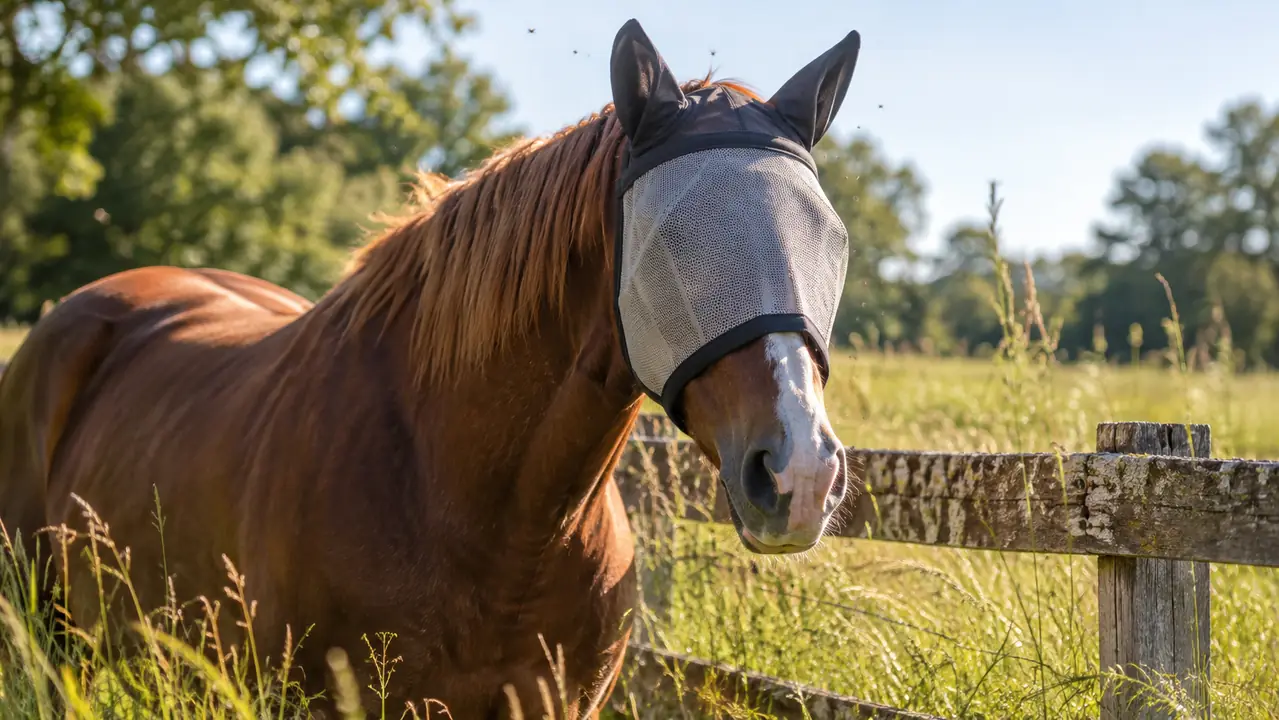
The first week of July, the flies found Dusty's eyes before I found my coffee. He stood at the gate with his head low, stomping a hind foot and dragging his face along the fence rail. If you have kept a horse through a western New York summer, you know that sound. I had tried a spray that quit by noon and a cheaper mask that rubbed a bare spot behind his ears in two days. So I ordered the Harrison Howard CareMaster Pro Luminous fly mask with ears in full size and put it on him the afternoon it arrived. Dusty is a 14-year-old sorrel Quarter Horse gelding, about 15.1 hands, and he is not dramatic about much. He let me fasten it and went back to grazing.
I am Shelby Hartwell. I ride trails on back roads and state forest tracks on weekends, haul in a two-horse bumper-pull trailer, and keep Dusty at home on a small acreage outside a small farm town. I am not a show-barn professional and I do not test gear in a laboratory. I test it on a horse that lives outside, sweats, rolls, and finds every fence post on the property. That is the standard this review uses. A fly mask has one job in my barn: keep flies off the eyes and ears without creating a new sore for me to treat.
The Quick Verdict
For daily turnout and trail rides, the Harrison Howard CareMaster Pro is the first fly mask that lasted a full summer on Dusty without rubs or lost closures. The mesh holds its shape, the eye space stays clear, and the touch-and-go tabs still grip after months of use. Deep mud and a horse that hooks fences with its head can still beat it.
Amazon Check Today's Price →A Fly Mask That Survived June, July and August
Dusty wore the Harrison Howard CareMaster Pro through daily turnout, weekend trails and the county fairgrounds. It stayed on and kept its shape.
Amazon Check Today's Price on Amazon →How I've Used It
Dusty wore this mask from the first hot week in June through the middle of September. It went on in the morning before turnout and came off at night for grooming, unless I was running late and left it on overnight. That happened maybe a dozen times. He wore it on trail rides at home, on two state forest rides, and at a local fun show where he stood tied to the trailer for most of the afternoon. I washed it by hand with a hose and a bucket of plain water every couple of weeks, and I let it dry over the stall door. No dryer, no bleach, no special soap. I wanted to know what a normal horse owner would do, not what a product tester with a timetable would do.
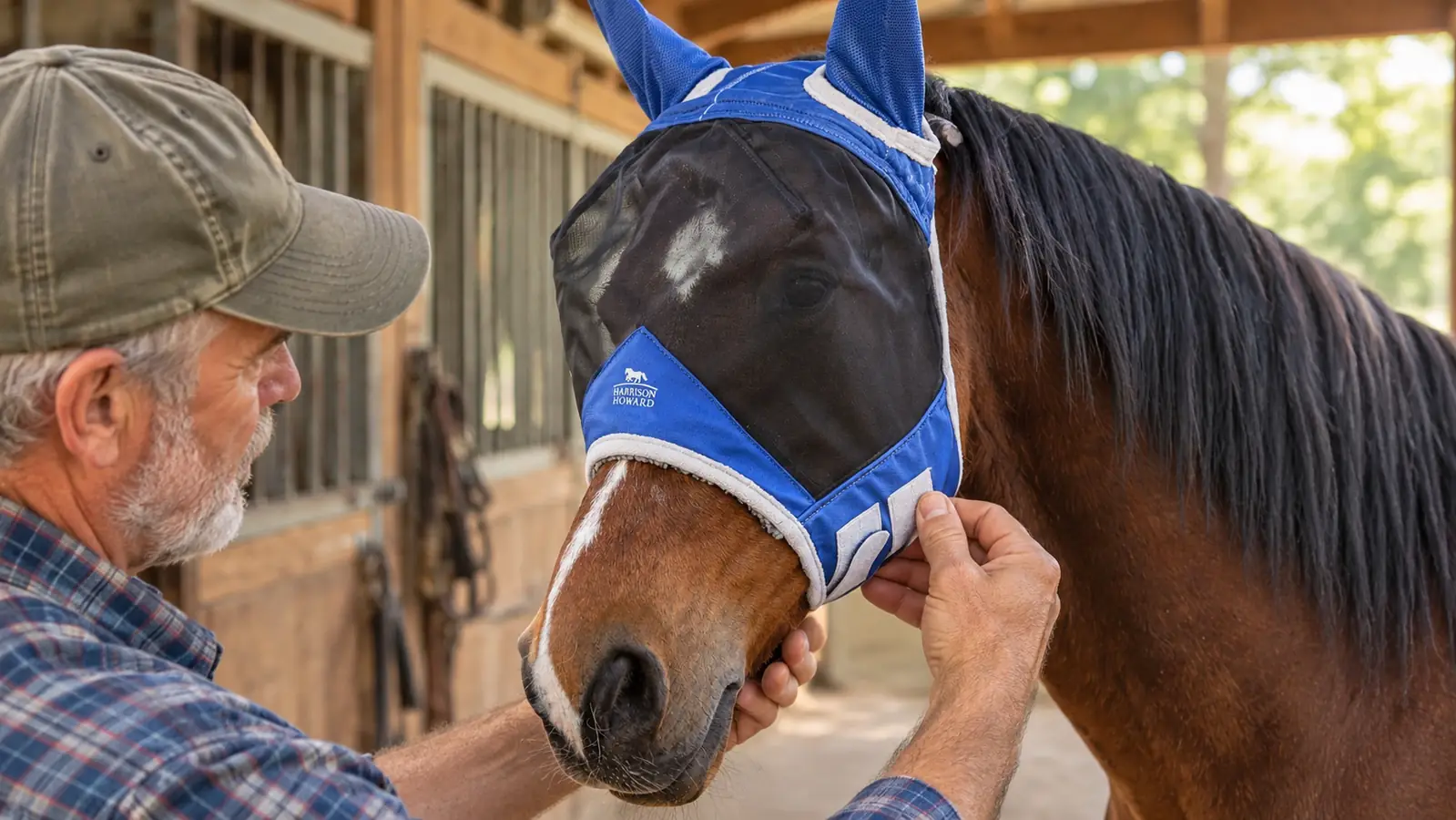
The first two weeks were about fit. The mask is a full size and Dusty is 15.1 hands, so I had some room to adjust the closures. I checked behind his ears, under his jaw, and around the eye openings every morning. A fly mask that fits well should sit away from the eyelashes and leave enough space that blinking does not rub. The CareMaster Pro has a large eye space, and that was the first thing I noticed. The mesh did not lie against his eyeballs. It also did not gap so wide that a determined deer fly could walk in from the side.
By the end of week three, Dusty had stopped trying to rub it off on the water trough. That is my real fit test. A horse will tolerate a bad mask for a while, then he will tell you. He will hook it on a fence, paw at it, or rub his head until a closure gives. Dusty did none of that after the first few days. He rolled in the pasture with it on. He ate hay with it on. He stood in the rain with it on. The mask came through all of it without a torn seam.
Fit and Coverage on a 15.1-Hand Quarter Horse
Fit is where most fly masks fail me. Dusty has a broad forehead and a thick jaw, and some full-size masks sit too tight across the brow or leave a gap under the throat. The Harrison Howard CareMaster Pro adjusted wide enough at the touch-and-go closures to sit flat without pulling. I could slide two fingers under the edge behind his jaw, which is my rule of thumb. The ears are covered, which matters in late July when the deer flies come out. I checked the ear tips daily for crust or rubbing. I found none.
The eye space is the part I watched most. A horse's eyes are on the sides of the head, and a mask that presses the lashes can cause watering, squinting, or a rubbed spot in a hurry. The large eye space on this mask kept the mesh off the eye itself. Dusty could see forward and to the sides well enough to walk the fence line and find the gate. He is a steady horse, but he is not blind-stupid. If a mask blocks too much of his side view, he gets sticky about walking into the barn. He walked in fine with this one.
The full-size coverage also kept the sun off the thin skin around his eyes and the base of his ears. I cannot say it stopped every fly from landing on his nose, because it did not. The mask covers the face and ears, not the whole head. Flies still found his muzzle and neck. What it did do was stop the constant head shaking and face rubbing that wears a horse down in hot weather. That was worth the daily check.
Mesh, Visibility and UV Protection
The listing says the mesh is ultra-fine, ventilating and lab-tested for UV protection. I can speak to the ventilation and the wear. I cannot run a UV meter, so I will not pretend I measured the protection. What I can tell you is that Dusty sweated under the mask on a 90-degree day and the mesh did not turn into a wet rag against his face. Air moved through it. The mask dried fast after a rain. The mesh held its shape after hand washing and did not stretch out at the eye openings.
Visibility matters more than people think. A fly mask with thick material can make a horse spooky in low light. This one is fine mesh, so Dusty could see the ground and the fence line. I rode him on the trail with it and he did not stumble or shy at the usual stump that bothers him. I would still take the mask off for a hard ride in deep brush, because branches can catch any mask. For pasture turnout and easy trail miles, it stayed on. The UV claim is a bonus I cannot verify, but the shade over his eyes was obvious on bright afternoons.
One thing I noticed: the mask does not trap heat the way a solid fly sheet can. The mesh is thin enough that I could see his coat through it. That also means it is not armor. A sharp branch or a horse that rubs hard on a rough fence can snag it. Dusty put a small pull in the mesh near the throat latch when he rubbed on the gate, and I stitched it with heavy thread. The mask did not fail at the seam. The mesh itself caught, which is what you would expect from a lightweight ventilating material.
Closures, Rubs and Daily Wear
The touch-and-go closures are the reason this mask stayed on. I have used masks with buckles that loosened in the pasture and masks with hook-and-loop that filled with hair and quit sticking by August. The CareMaster Pro uses touch-and-go tabs, and they still held after months of daily use. I did clean hair out of them with a pocket knife every week or so. That is not a flaw in the mask. That is just what hook-and-loop does. I adjusted the closures for Dusty's jaw, and they did not rub a bald spot under his throat.
I checked for rubs every evening for the first month. The spots I watch are behind the ears, under the jaw, and at the cheek where the mask meets the head. I found a small crease behind one ear in the first week, but it was from the mask sitting a little low, not from a bad edge. I loosened the closure one notch and it went away. After that, no rubs. The ergonomic design is supposed to prevent rubbing, and in our case it did once I had the fit right. I want to be clear: fit is not automatic. You have to adjust it and check it.
Dusty is girthy about tack that fits wrong, and he is just as clear about head gear. If a mask pinches, he tosses his head and walks away. He stood for this one after the first week. He also kept it on through a windy night, which surprised me. The closures stayed put. The mask was still on his head at morning feed. I cannot say every horse will do that. A horse that has learned to hook a mask on a fence post can defeat almost anything.
The real test was not the first day. It was the morning in August when Dusty was still wearing it, still sound, and had no new rub behind his ears.
What a Full Summer Taught Me
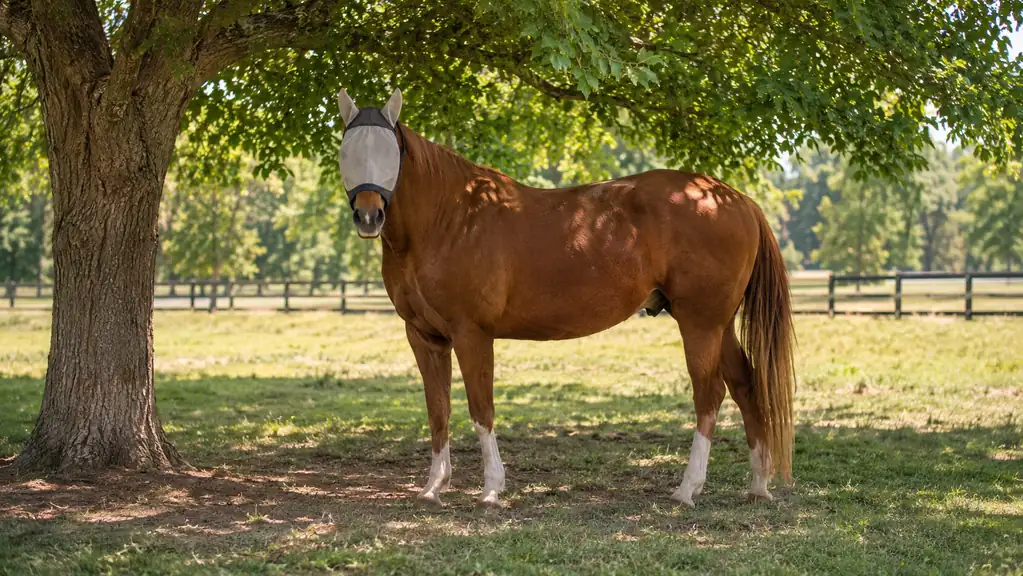
By September, the mask looked used. The mesh had lost that new stiffness, the edges were a little soft, and there was a faint stain along the brow from sweat and dust. That is normal. What mattered was that it still fit and still stayed on. I did not have to replace a closure. I did not have to treat a rub. I did not have to chase Dusty around the pasture because the mask was hanging off one ear. For a piece of gear that gets this much daily use, that is a fair summer.
The package lists the mask at 6.74 ounces and 11.93 by 8.58 by 1.18 inches. I did not weigh it, but it is light in the hand. Dusty did not act like he was wearing a helmet. That matters on a hot day. The weight and the mesh together are why he tolerated it. I also liked that the mask went on without a lot of fuss, which matters when I am late for work. The closures are simple and the mask goes on in seconds once you have the fit set.
Would I buy it again? Yes. I already have a second one in the tack room for next summer, because I have learned that fly masks fail at the worst possible time, usually the week the flies are worst. I would not call it indestructible. I would call it dependable. There is a difference. Dependable means it does the job day after day without a new problem. That is what this mask did.
What I Liked
- Stayed on through daily turnout and overnight wear
- Large eye space kept the mesh away from the eyes
- Touch-and-go closures still held after months of use
- Ventilating mesh dried fast after rain and sweat
- No rubs once I adjusted the fit behind the jaw
- Ears covered through the worst of the deer fly season
Where It Falls Short
- Mesh can snag on rough fences or sharp branches
- Hook-and-loop tabs need hair cleaned out regularly
- Full size may be too roomy for a pony or very small horse
- Does not replace fly spray on the muzzle, neck and body
- A horse that deliberately hooks masks on fence posts can still beat it
Who This Is For
For trail riders, 4-H families, and small-acreage owners who turn a horse out daily, this mask makes sense. It is also a good fit for a horse with a broad forehead or a thick jaw that has popped the closures on cheaper masks. If you want a mask that covers the ears and leaves generous eye space, the Harrison Howard CareMaster Pro is worth putting on your short list. It is built for everyday pasture and light riding, not for turnout in a briar patch.
Who Should Skip It
Skip it if your horse is a known mask destroyer. I mean the horse that hooks a mask on a fence post every single day, or the one that rubs on a round bale until anything on its head comes off. This mask is sturdy, but it is still mesh and touch-and-go closures. It is not a steel cage. Skip it if you need a fly mask for a very small horse or a pony, because the full size may be too much. And skip it if you expect a mask to replace fly spray on the muzzle, neck and body. It will not.
If Your Horse Rubs Every Other Mask, Try This One
The Harrison Howard CareMaster Pro stayed on Dusty for a full summer, kept its shape, and left no rubs once I set the closures. Check the current size and availability before you order.
Amazon Check Today's Price on Amazon →