

Short answer first: for a horse with a wide face and eyes that water in the sun, I would put the Harrison Howard CareMaster Pro on and stop shopping. Dusty is 14 this year, a sorrel Quarter Horse gelding right around 15.1 hands, and he wears a fly mask every turnout morning from May until the first hard frost. The Cashel Crusader is a good mask with a long following and I am not going to pretend otherwise. It just fits him differently, and that difference is the reason I have bought the Harrison Howard CareMaster Pro twice now.
Here is what decides it for me. The CareMaster Pro is cut with a large eye space, so the mesh sits out away from the lashes instead of resting down on them. The Crusader is built close to the face, which is exactly right for a lot of horses and exactly wrong for mine. Dusty rubs. He rubs on the water trough, on the gate latch, on the corner of the run-in shed. Every mask we tried before this one ended up somewhere out in the pasture by the second week. If your horse has never rubbed a mask off in his life, buy whichever one suits your wallet and be done with it. If he has, eye room is the whole conversation and everything else in this article is a footnote.
| Harrison Howard CareMaster Pro | Cashel Crusader | |
|---|---|---|
| UV protection | Ultra-fine ventilating mesh with lab-tested UV protection | Coated mesh built to block sun |
| Eye clearance | Large eye space holds the mesh off the lashes | Close cut, so the mesh sits nearer the face |
| Ear coverage | Ears are part of the standard mask | Ear coverage is a separate model to shop for |
| Staying put at turnout | Touch-and-go closures at the throat | Close fit and under-jaw closure make it harder to rub off |
| Style options | One standard configuration with ears | More cuts and variations to choose from in the line |
| Weight | 6.74 ounces per the listed package weight | Close enough that a horse will not notice the difference |
| Cost | Lower of the two at the tack shop | Higher, and the ear version runs higher again |
| Best for | Wide-faced horses that need room around the eye | Horses that keep a close-fitting mask on |
Where the Harrison Howard CareMaster Pro Wins
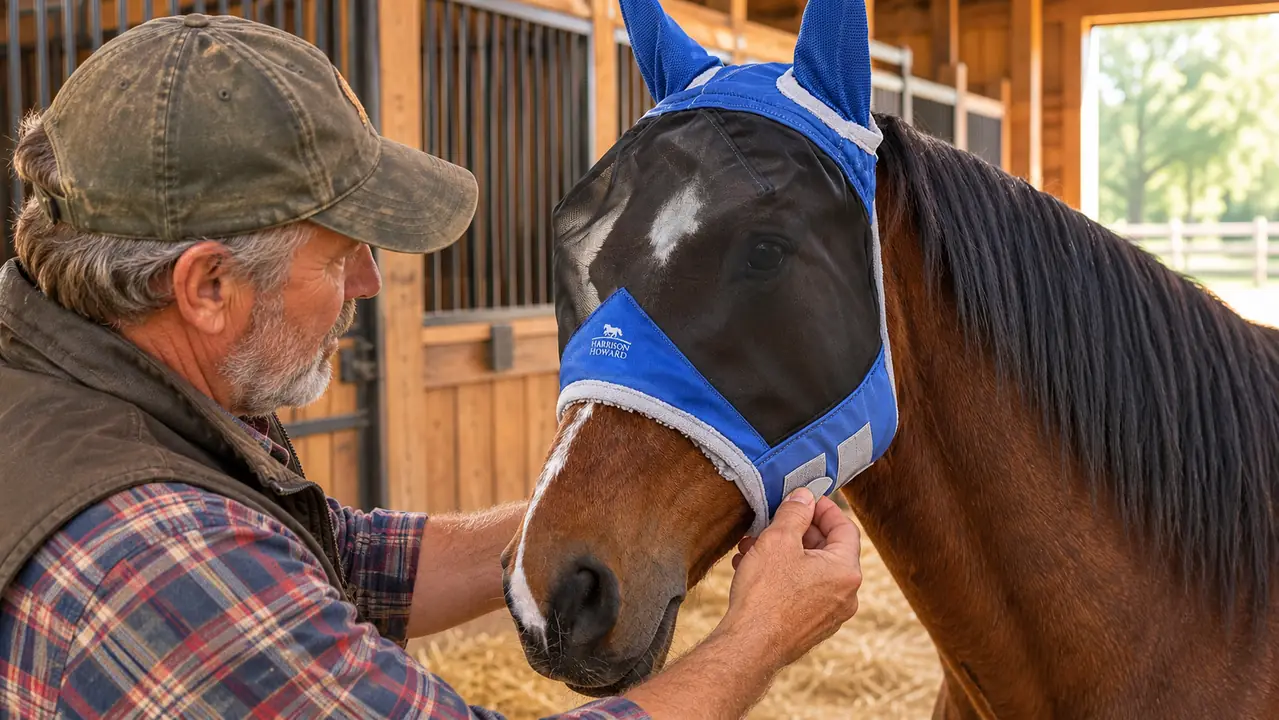
Eye room is number one and there is no close second. The large eye space keeps the mesh far enough off the eye that a horse can blink and swing his head without dragging fabric across a lash. On Dusty that means no watery eye at the end of a ride and no rubbed bald patch at the corner. The listing describes the design as ergonomic and built to sit without rubbing, and for once the marketing copy and the horse agree. I have put my hand under that eye hole and there is real clearance in there, the kind you can feel with two fingers.
Second is ears. They are part of the standard mask, not a separate model you have to hunt down and pay more for. In a bad fly year that matters more than people give it credit for, because the ears are where the flies land first and where a horse has the least defense. Third is the mesh itself. It is ultra-fine and it ventilates, so a horse is not cooking under it in July, and it carries lab-tested UV protection, which does honest work on a light-skinned horse that sunburns on the muzzle and around the eyes. Fourth is the closure. Touch-and-go at the throat is plain hook and loop, easy to fasten one-handed in a dim barn aisle and easy to peel open with cold fingers.
Where the Cashel Crusader Wins
It stays on. I will give the Crusader that all day long and twice on a windy Tuesday. The closer cut means there is less fabric out there to catch on a fence post or a low branch, and the way it closes under the jaw holds a quiet horse well. On a horse that simply wears a mask and forgets about it, the Crusader is the one I would trust in a big pasture with weather coming. Dusty is not that horse. He is the horse that teaches you why people own spare halters.
The other thing the Crusader gives you is choices. That line comes in more cuts and variations, so you can work around a narrow head or a short face or a horse that will not tolerate anything over his ears. The CareMaster Pro is a standard configuration with ears built in, which is simpler to buy and less flexible once it is on your horse. And a mask that has been on the market this long has had plenty of chances to be found out. It is still selling for a reason, and the reason is that on the right horse it just plain works.
The Mask That Finally Stayed Off His Lashes
Large eye space, ears built in, ultra-fine ventilating mesh with lab-tested UV protection, and a touch-and-go throat closure that holds. This is what went on Dusty every turnout morning this season.
Amazon Check Today's Price on Amazon →Who Should Buy Which
Buy the Harrison Howard CareMaster Pro if your horse has a broad forehead, a wide face, or a history of coming in from turnout with a watery eye and a rubbed corner. Buy it if you want ears included without hunting a second listing. Buy it if you are the person who has already sent two masks back this season and is tired of the whole exercise. That was me. I am not embarrassed about it.
Buy the Cashel Crusader if your horse wears a mask without complaint but loses them out in the pasture, or if you have a narrow-faced horse that swims in anything cut generous. Both are honest masks built for two different problems. There is no bad guy here. There is only the shape of your horse's head and how much he objects to fabric near his eye.
How I Compared Them
I am not a lab and I am not going to pretend I ran one. What I did was simpler and slower. Dusty wore both masks across a full fly season on the same rotation of morning turnout, back road rides on weekends and a handful of summer mornings at the local show grounds where I mostly stand around and visit. I checked him at evening feed for rubs, for watery eyes and for whether the mask was still on his head. I kept track of which one he rubbed off, which one he left alone, and which one came in with mesh pressed flat against an eye.
That is not a controlled study. It is one horse in western New York with one opinionated owner, and you should weigh it the way you would weigh any advice you get leaning on a fence. But it is also how most people actually pick gear. Nobody stands in a tack shop comparing thread counts. You buy the one that stays on your horse and does not rub him, and then you buy it again next spring without thinking about it.
The first mask that stayed off Dusty's lashes for a whole season was the one cut with a large eye space, and that is the only thing about it that ever mattered to him.
The Eye Space Question, in Plain Terms
Mesh against an eye is not a small problem dressed up as a big one. A horse's lashes are long and they catch on fabric, and once a mask starts dragging across the eye the horse learns to rub. Rub hard enough on a fence post and you have a mask on the ground and a horse with a raw spot at the corner of his eye that takes a week to heal. The fix is clearance. Clearance is a matter of pattern, not adjustment. You cannot add room to a close-fitting mask after the fact, and no amount of fiddling with the throat closure will change the shape of the eye hole.
What surprised me was how much of the difference showed up in behavior rather than appearance. Dusty stopped doing the head-shake-and-fling routine about four days into wearing the CareMaster Pro. I had assumed that routine was about flies, and part of it surely was. Most of it was the mask sitting on his lashes. A horse cannot tell you which part of the mask bothers him. You have to watch what changes when you switch, and then trust what you saw.
What the Mesh Actually Does
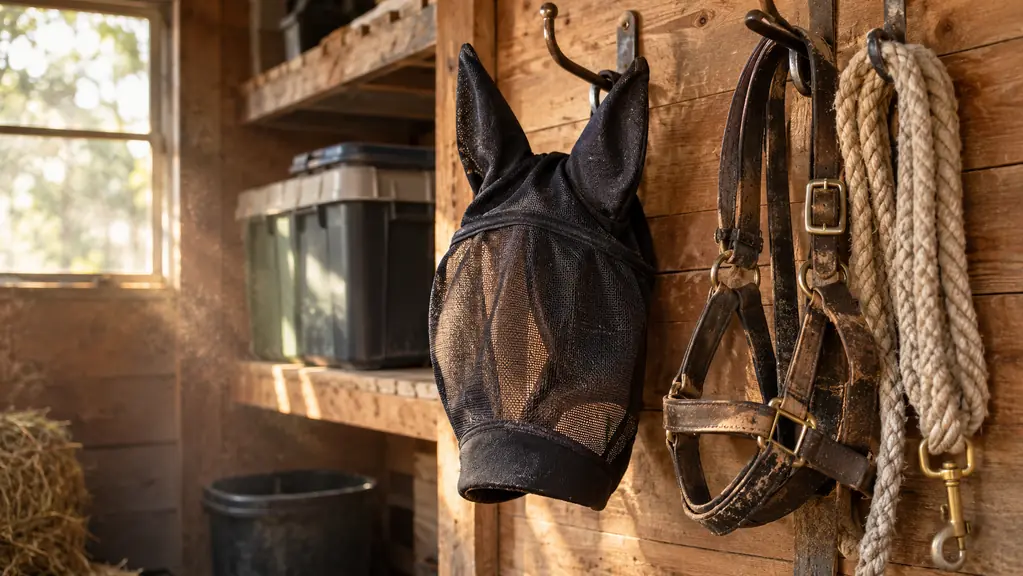
The listing calls the mesh ultra-fine, ventilating and long-lasting, with lab-tested UV protection, and it is described as helping prevent sun damage to the skin. I can speak to the ventilation from the outside. On a still afternoon in the high eighties, Dusty's forehead under that mask is warm but not wet, and a horse that is genuinely overheating will let you know by standing in the water trough. I have also had a light-skinned mare in the past who burned pink across the muzzle every June. A UV-blocking mask over the face is not a luxury on a horse like that. It is the difference between a comfortable summer and a scabby one.
What I cannot tell you is how many seasons the mesh lasts, because I am only one season in on this one. What I can tell you is that it has been washed, hosed off, dragged through a fence line once and hung on a hook to dry more times than I can count, and it has not frayed or gone see-through. The listing says the material is sturdy enough to handle wear. So far that reads true.
Ears: Built In or Bought Separate
The CareMaster Pro comes with ears as part of the standard mask. That sounds like a small detail until you have priced an ear piece separately, or worse, ordered the earless version by mistake and spent a week watching flies work on the inside of your horse's ears while you waited for the right one to arrive. If ear coverage is what you want, having it in the standard model is one less decision to make at eleven at night with a phone in your hand.
The tradeoff is that you do not get to choose. If your horse hates anything over his ears, the built-in version is the wrong pick and you are better off with a line that lets you buy the earless cut. Dusty does not care either way. He has never once objected to ears. He objects to the eye area, loudly, by rubbing.
Sizing Notes Before You Order
The mask I have is a full size with a large eye space. Full size is not a universal fit, so measure instead of guessing. Run a soft tape from under the jaw, up one cheek, across the forehead and down the other cheek, and hold that number against the size chart. Dusty measured into a full size with room to spare, and the touch-and-go closure still had plenty of tail left over after fastening, which is what you want. A closure that is maxed out is a closure that is going to pop the first time he shakes.
If you are between sizes, go smaller on a close-fitting mask and larger on a generous one. That sounds backwards and it is not. A generous mask that is too big slides sideways and puts the eye hole in the wrong place, which is the exact failure you were trying to avoid in the first place. Fit is not a fashion question on a fly mask. It is the entire function.
What Neither Mask Fixes
Neither mask is going to keep flies off the muzzle, the throat latch or anything below the jaw, and if your problem is face flies landing on the nose you need a different piece of gear entirely. Neither one replaces fly spray on a bad day, and neither one is going to survive a horse that has decided the fence line is a scratching post. If you have one of those, buy two and keep one in the tack room. That advice has saved me more money than any product comparison ever will.
And neither one is a substitute for putting your hands on your horse. A mask can hide a problem, and it can also cause one if you stop looking. I pull Dusty's off at evening feed every single day and I look at both eyes and the skin underneath. Twice this season I found a small spot rubbed at the cheek, and both times it traced back to a closure that had worked loose rather than to the mask itself. Tighten it, check again in two days. That is the whole maintenance routine.
What I'd Hand You Over the Fence
If your horse's eyes are anything like Dusty's, this is the mask I would put in your hand. Large eye space, ears included, UV-blocking mesh, and a throat closure that holds all day. It went on him every turnout morning and it is the first one that stayed there.
Amazon Check Today's Price on Amazon →