

I have a confession that will not win me any friends in the tack room: I rode without a helmet for about fifteen years. Not because I thought I was invincible. Because the helmets I tried felt like wearing a bucket with a chin strap, and I would rather have been a little stupid than a little deaf and sweating. That is the honest starting point for this Troxel Spirit review, and it is the reason I have opinions about it that a person who has only worn it in a tack store does not.
So when I finally bought the Troxel Spirit about two years ago, I wanted it to be the last helmet conversation I ever had. It has mostly been that. But this is the what-nobody-tells-you version, not the polished one. There are three things that still bug me, and I will get to all of them. First, the short version.
The Quick Verdict
A genuinely comfortable, low-profile everyday helmet with real ventilation and a dial fit that stays put on the trail. What bugs me is the liner, the visor, and the size chart.
Amazon Check Today's Price →The helmet I keep grabbing on the way out the barn door
Current price and the full size range are on the Amazon listing. Check the size chart against your actual head measurement before you order, because that is where most of the complaints start.
Amazon Check today's price on Amazon →How I've Actually Used It
Dusty is a 14-year-old sorrel Quarter Horse gelding, about 15.1 hands, and he is steady on the trail but barn-sour in a way that makes the first mile interesting. We ride back roads and state forest trails on weekends, and I haul him in a two-horse bumper-pull to the local open show grounds a few times a summer to watch and occasionally to enter a fun class.
That is the whole use case. No eventing, no hunting pace, no galloping. If you are looking for a helmet review from somebody jumping three-foot fences, this is not it, and I would rather say so now than waste your afternoon.
The Spirit has been on my head for probably a hundred and fifty rides at this point, plus a lot of hot hours standing around at a show grounds in July. It has been rained on, dropped on gravel, stuffed in a tack trunk, and hung on a fence post more times than I should admit. Nothing has cracked, nothing has delaminated, and the dial has not gone soft.
For scale, the whole thing weighs a little under two pounds by the listing, and the shell measures roughly thirteen inches front to back in the size I have. That sounds like trivia until you have spent an afternoon in a heavier helmet and felt your neck at suppertime. The first long ride I took in it, I kept reaching up to check it was still there, because my old hand-me-down had trained me to expect a certain weight on my head and this one did not deliver it. By the third ride I had stopped noticing altogether, which is the highest compliment I can pay a piece of gear.
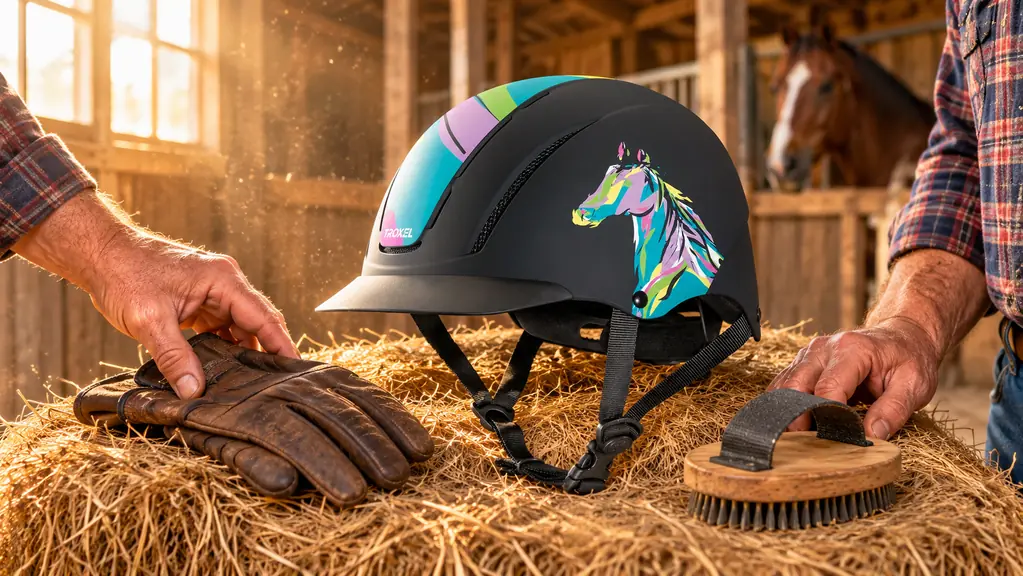
What Nobody Tells You About the Fit
Here is the first thing. The Troxel Spirit is adjustable, and adjustable does not mean one size fits all. It means there is a dial at the back that lets you fine-tune a shell that is already nominally your size. The listing runs sizes from Small up, and Small is a real size, not a marketing label.
I measured my head with a soft tape the way the size chart says to, came out toward the low end, and ordered accordingly. It fit out of the box with maybe a quarter inch of dial to spare. A friend of mine has a rounder head than mine and ordered the same size, and she had to send it back. Same measurement on paper, different head shape, different result.
That is the thing nobody puts on a product page. The dial fixes circumference. It does not fix shape. If you are long from front to back and narrow across, this shell will suit you. If you are very round, try before you commit if you can, or buy from somewhere with an easy return.
The other fit detail I would tell a friend: it sits low. The shell comes down closer to the brow than the old-school helmets I grew up borrowing, which is the point of the low-profile build, but it means if you have a low hairline or you wear your hair up, you will notice it. I wear a thin skull cap under mine and that solved it entirely.
One more fit note that took me a while to figure out. I first had the dial cranked down tighter than I needed, because the helmet felt slightly loose at the crown when I tipped my head forward, and my instinct was to fix it with the dial. That was the wrong tool. What actually happened is the padding compressed over the first month of steady riding, and once it did, the fit settled in on its own. If I had gone a size down to chase that early looseness I would have ended up with a helmet I could not wear past April. Give the padding four or five rides before you decide the size is wrong.
The dial fixes circumference. It does not fix head shape. That is the sentence I wish somebody had put on the product page.
The Ventilation Is Not Marketing Talk
My first helmet was a hand-me-down with no vents at all, and by the top of a hill in August I would be wiping sweat out of my eyes with a shirtsleeve while Dusty wondered why we were stopped. The Spirit has vents set into the shell, and they do something.
I am not going to tell you it feels like air conditioning. It does not. But on a ninety-degree day last July I did a two-hour ride and my hair was damp, not soaked, and I was not dizzy at the end of it. That is a real difference and it is the single biggest reason I stopped dreading the helmet.
The tradeoff, and there is always one, is that vents let dust in. On a dry gravel road behind a truck, I get grit in my hair. It rinses out. I will take grit over heat stroke every single time.
I tested this more deliberately than I meant to. Back in August I did the same loop two weekends running, the same six miles of gravel and shaded two-track, once starting at nine in the morning and once at two in the afternoon, and I paid attention on the climb out of the creek bottom both times. The morning ride was nothing. The afternoon ride, the one where the sun sits on the back of your neck and the horse is walking slow because he is hot too, is the one where a helmet either breathes or it does not. I finished that second ride with a damp forehead and I was not seeing spots. Two summers ago on the old shell I would have been sitting in the shade with my head between my knees for ten minutes before I could untack.
What Bugs Me
Now the part that the four-and-a-half-star reviews gloss over. None of these are dealbreakers. All of them are true.
The liner is not washable the way I wanted
The interior is expanded polystyrene with a padded liner, and the liner does not pop out for machine washing the way a lot of modern bike and ski helmets do. You wipe it. That is the option. After a summer of use, a helmet you cannot throw in a bucket of soapy water starts to have a smell, and mine does, faintly, in the padding at the brow.
I have gotten around it with a thin washable skull cap worn underneath. That keeps most of the sweat out of the pad and I can wash the cap in the sink with dish soap. It is a workaround, not a fix, and I would pay real money for a removable liner.
What I actually do now, once a month or so, is take a cloth dampened with a little mild soap and warm water and work it along the brow padding in short strokes, then wipe it again with plain water and let the helmet sit upside down on the porch rail in the shade to dry. Not in the sun, because I do not want to bake the foam. It takes five minutes and it knocks the smell back to nothing for a few weeks. It is not a deep clean and I am not pretending it is. It is the difference between a helmet that smells like a horse and one that does not.
The visor is fixed, and it is a sun visor, not a rain visor
The Spirit has a visor, and the visor does its job in low sun. What it does not do is keep rain off your face, and it does not move, so you cannot flip it down or up depending on what the sky is doing. On a ride where the weather turns, I have ended up with water running straight down my nose while the visor sat there being decorative.
I also notice it in wind. Not dangerously, just enough that on a gusty ridge I am aware of the brim. Riders who do a lot of open country might care about that more than I do on wooded trails.
The rain ride is worth describing because it is the one that taught me the lesson. Late September, a two-hour loop I had ridden a dozen times, sky gray but not threatening when I tacked up. About forty minutes in it came down steady and sideways and never let up. The visor gave my eyes a little shelter when we were pointed straight into it and did absolutely nothing when the wind turned it crossways. By the time we got back to the trailer my shirt was soaked through and my face was wet enough that I was blinking to see the gate latch. A brim you could tip down would have helped. This one cannot be tipped. If you ride in country where the weather turns fast, budget for a rain shell with a hood that fits over the helmet, because the Spirit's visor is not going to do that job for you.
The chin strap takes getting used to
This might be my head, but the strap sits close to the front of my throat in a way that took a few rides to stop noticing. I run it snug under the chin and it is fine now. The first three rides I kept hooking a finger under it to check I was not choking myself, which is a bad habit to build.
Set it once, correctly, standing in the barn, and leave it. If you fiddle with the strap on horseback you will end up with it loose, and a loose helmet is a hat.
What I Liked
- Genuinely comfortable for a full day, and the dial holds its setting ride after ride
- The vents make a real difference on a hot afternoon climb, not just on paper
- Low-profile shape looks like a modern helmet instead of a borrowed bucket
- Polycarbonate shell has taken two seasons of being dropped and stuffed in a tack trunk without a crack
- Adjustable fit means you can dial in after the padding settles instead of guessing a size down
Where It Falls Short
- The liner does not come out, so a monthly wipe down is the only cleaning you get
- The visor is fixed and sheds sun, not rain
- The chin strap sits forward enough to notice for the first few rides
- Rounder head shapes may need to return it, and the size chart will not warn you
- The one-year warranty covers defects, not a drop on the barn floor

What Held Up and What Didn't
Two seasons is enough time for gear to show you what it is. The shell itself has been the pleasant surprise. Polycarbonate over foam, and it has taken the ordinary abuse of barn life, which for me means being set down on a fence post, knocked off a shelf in the tack room, and once dropped flat on the gravel apron while I was wrestling with a hay bale. No cracks, no spidering, and the outer finish has not gone chalky the way cheap plastic does after a couple of winters.
The dial is the other piece that has held. I have had adjustable things where the click mechanism softens up after a few months and the whole helmet starts to wander. This one still clicks positively and still holds where I set it. I check it out of habit before every ride and I have not had to change the setting since the padding settled in that first spring.
What did not hold up perfectly is the padding, and that is the honest answer. The brow area has compressed and gone slightly shiny where it takes the most contact, and that is part of why the liner complaint matters more in year two than it did in month one. The helmet still fits. It just looks like it has been worn, which it has.
Who This Is For
The Troxel Spirit suits a rider who wants one helmet for everyday barn work, trail miles, and the occasional local show, and who does not want to spend a fortune getting it. That is exactly the rider I am, and it is why the helmet has stayed on my shelf while my old one went into the giveaway pile.
It also suits a rider who is coming back to horses after years away, because the dial fit forgives the uncertainty of not knowing your size, and the low-profile shape does not look like you borrowed your grandmother's helmet. There is something to be said for a piece of safety gear that you do not feel silly wearing, because gear you feel silly wearing is gear that stays in the tack room.
And it suits a rider who runs hot. If you have ever taken a helmet off mid-ride because you thought you might pass out, this is a meaningful upgrade over the entry-level shells that have no airflow at all.
Who Should Skip It
If you show seriously in a discipline with a required helmet standard and appearance, buy the helmet your association and your trainer tell you to buy. A four-and-a-half star trail helmet is not a show-circuit answer, and I would not pretend otherwise.
If you have a very round head and no patience for returns, this may not be your shell. Order from a seller with a straightforward return policy, or go put hands on one first.
And if a removable, machine-washable liner is a hard requirement for you, skip this and look at something built around that. I solved it with a skull cap and I am content, but I would be lying if I said it did not annoy me every July.
The last group I would steer away is anybody who wants to buy one helmet and be done thinking about it for a decade. Foam helmets have a service life whether you like it or not, and this one is no exception. If you are the kind of person who will keep the same shell on a hook for fifteen years because it still looks fine, do yourself a favor and skip the whole category rather than buy this and then ignore it.
What I'd Tell You If We Were Sitting in the Tack Room
Measure your head. Actually measure it, with a soft tape, the way the size chart says, not by guessing off a hat size. Then order one size and expect to use the dial. Do not order big thinking you will grow into it, because a helmet that is too big slides, and a helmet that slides is not doing the one job you bought it for.
Get a thin washable skull cap to go under it. Two of them, actually, so one can be drying while you ride in the other. It will save you the liner problem, it will keep your hair out of the padding, and it costs less than a bag of feed.
Check the strap every single time. Not because the Troxel Spirit is prone to coming loose, but because every helmet is, and the habit is what keeps you safe. I check mine at the hitching post before I mount, same as I check Dusty's cinch, and I have caught a loose strap more than once.
Store it out of the sun and off the floor. Mine lives on a shelf in the tack room I built myself, upside down so the padding can air, and it has made a difference to how the inside has held up compared to the fence-post habit I had the first summer. Heat and sunlight are hard on foam, and a tack trunk in July is basically an oven. If your only option is a hot trunk, at least put it in a cloth bag and keep it off the black rubber mat.
And replace it when it has taken a real hit. This one is not fun to hear and it is not cheap, but the warranty on this helmet is a limited one year against defects, not against a drop onto the barn floor or a fall with your head in it. If it takes a hard knock, it is done. That is true of every helmet and nobody likes to say it out loud.
The short version, after two seasons: the Troxel Spirit does the everyday job well, at a price that does not make me wince, and the handful of annoyances are the kind you learn to work around. I would buy it again. I would just buy it in the right size the first time and with two skull caps in the cart.
Two seasons in and it's still the one by the door
If you want the same everyday helmet I keep reaching for, the listing has the current price and the size range. Measure first, then order.
Amazon Check today's price on Amazon →