
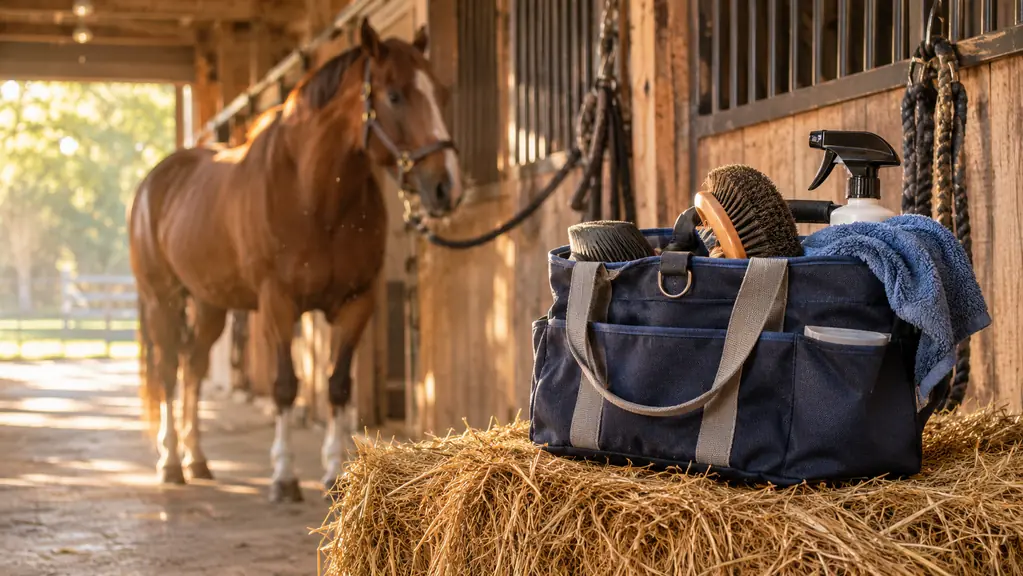
If you have ever stood in a tack shop holding one brush, trying to decide whether it was worth buying on its own, this review is for you. I spent years buying grooming tools one piece at a time, and I still have a plastic tub in my tack room full of the ones that did not earn their place. Last spring I stopped doing that and bought the Weaver Equine 7-Piece Grooming Kit instead. It arrived as a set in a tote bag with everything in one place, and I have used it every single day since on my Quarter Horse gelding, Dusty.
Here is the short version, the one I would give you over the fence: the tools are solid, the bag is the real reason to buy the kit, and there are two pieces inside it I reach for maybe once a month. That is the whole honest review in three lines. Everything below is the detail behind those three lines, because a grooming kit lives or dies on whether it survives a western New York winter of mud, manure and wet horsehair, not on how it looks coming out of the box.
The Quick Verdict
A well-made daily grooming set where the tote does as much work as the tools. Two pieces are filler and the plastic handles get slick when wet, but nothing in the bag has cracked or let go in a year of daily barn use.
Amazon Check Today's Price →Seven pieces, one bag, one trip to the barn
A tote with six outer pockets and webbing handles, plus a hoof pick, comb, sweat scraper and a set of brushes. This is the kit hanging on my stall door right now.
Amazon Check Today's Price on Amazon →What Nobody Tells You About Buying Grooming Tools as a Set
Nobody tells you that most grooming kits are built around one decent brush and a handful of things nobody asked for. I have opened a few of those in my time. You get a passable curry, a stiff little brush that scratches, a comb whose tines bend the first time they meet a knot, and a bag that gives out at the seam by August. The set looks like a bargain until you are back at the tack shop in September buying the pieces you actually needed in the first place.
That is why I hesitated on this one for so long. What changed my mind was a friend at the barn who had the same Weaver Equine tote hanging on her stall door for two full seasons. Not the brushes so much, the bag. She said the handles had not torn, the pockets still held, and the whole thing still carried like it did the day she bought it. I have had canvas totes give out at the strap in a single summer of hauling to trailheads, so that mattered to me more than any single brush in the set.
Here is how I would tell you to shop a set: buy it for the bag and the two or three tools you will genuinely use every day, then judge the rest on whether it is at least not in your way. That is a low bar, and this kit clears it. It is not a show-grooming kit and it does not pretend to be. It is a working kit, the kind that lives in the barn aisle and gets dragged to the trailer on a Saturday morning without much thought.
What Is Actually in the Bag
The kit is seven pieces in a nylon tote. The tote has six outer pockets, webbing handles, and enough structure that it stands up on its own when I set it down on a bale. The whole thing measures about eleven inches long, seven inches wide and eleven inches tall, and it weighs a little under three pounds, so it carries easily in one hand along with a bucket. Inside you get a hoof pick, a comb, a sweat scraper and a set of brushes, plus the tote itself. The bristles are plastic or rubber and the handles are plastic, which is the one specification I would change if I could.
Everything stacks in a rectangle, which sounds like a strange thing to praise until you have owned a round bag that rolls off the tailgate every time you set it down. The pockets are on the outside, so the hoof pick and the comb are right where my hand goes instead of buried under four brushes. That is a small design choice that saves maybe thirty seconds every time you pick up the bag, and it adds up to a lot of thirty seconds over a year of daily grooming.
Space is the part nobody thinks about until the bag is on the shelf. Mine sits on the second shelf in my tack room, the one I built into the wall myself, and it fits beside a stack of saddle pads with room left over. Eleven inches long and seven wide is small enough that it does not claim a whole shelf, which matters in a room the size of a closet. A friend of mine has a round canvas bag that takes twice the footprint and rolls off the tailgate every time she sets it down.
The warranty is listed as satisfaction guaranteed, which is vague but at least it is not silence. I have not had to test it. Nothing in my bag has cracked, split or come apart in a year of daily use, and that includes a hoof pick I have dropped on the barn concrete more times than I care to admit.
What I Liked
- The tote carries the kit: six outer pockets, webbing handles, and it holds its shape after a year on a stall door
- Every tool has a home, so nothing gets buried or left out in the aisle
- The hoof pick and sweat scraper have survived daily use and drops on concrete
- Light enough to carry in one hand with a bucket in the other
- The brushes handle everyday dirt and winter mud without scratching
- A complete set, which means I stopped buying grooming tools one piece at a time
Where It Falls Short
- Plastic handles get slick when your hands are wet or soapy
- The comb is the weakest piece in the bag for thick manes and tangled tails
- The small face brush is too stiff for a thin-skinned horse around the ears
- No divider inside the main compartment, so the big brushes pile up
- Not a show-grooming kit and not close to one
The Bag Is the Reason to Buy It
I want to spend a minute on the tote, because it is the part people skip past when they are looking at pictures. Six pockets on the outside means every tool has a place, and the horse cannot knock the bag over and scatter everything across the aisle. The webbing handles run the depth of the bag rather than being stitched on as an afterthought, which is exactly where cheap totes fail first. Mine has hung on a stall door hook loaded with seven pieces for a year, and the handle stitching has not started to pull.
It hauls well too. Mine rides in the truck bed when we trailer out to a trailhead, gets set down in the gravel, got rained on once, and still closes up and carries the same way it did on day one. If you have ever had a grooming bag split open in the back of a truck and spent twenty minutes fishing a hoof pick out from under a spare tire, you know why I am going on about this. The tools are good. The bag is what makes the kit worth buying as a kit.
How I've Used It
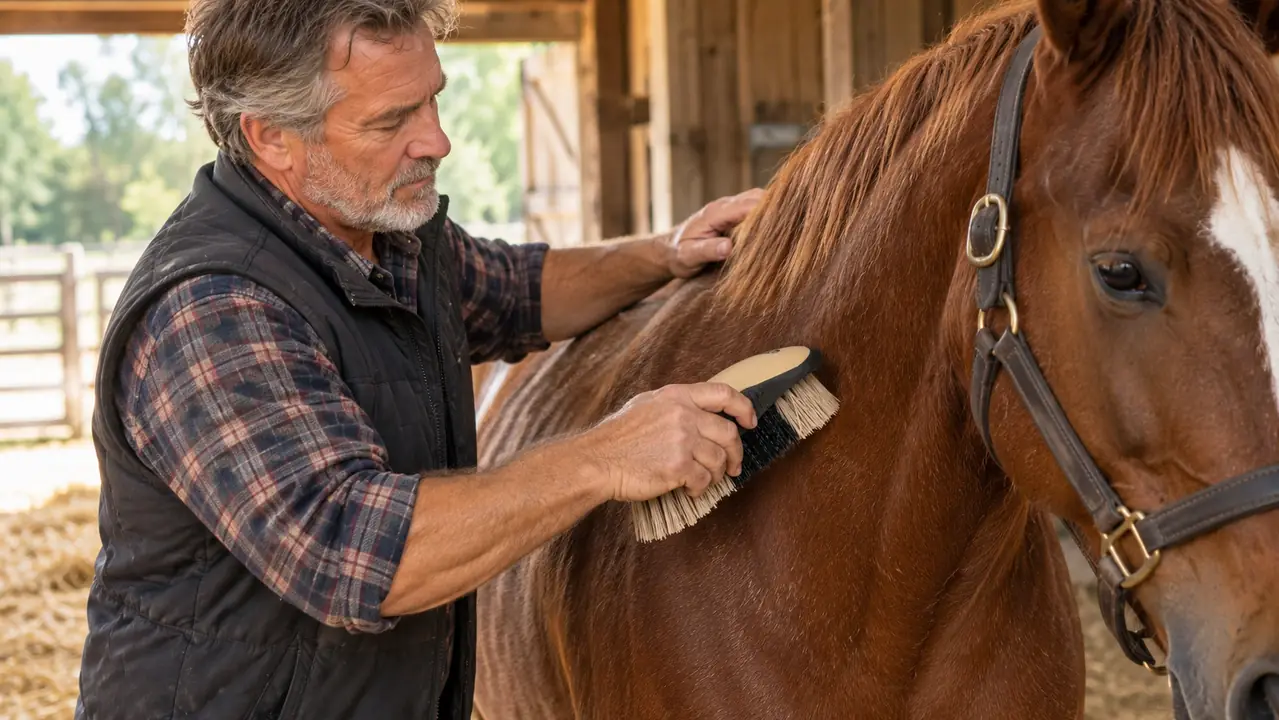
I have a 14-year-old sorrel Quarter Horse gelding named Dusty, about 15.1 hands, and he is not a delicate horse. He is steady on the trail and a little barn-sour, and he gets fussy about anything near his flanks, which means grooming has to stay calm, quick and predictable or he starts sidestepping in the aisle. My routine is the same most mornings: curry, then a stiff brush to lift the dirt out of his coat, then a soft brush over his face and shoulders, then the hoof pick on all four, then the comb through his mane and tail if we are going anywhere.
After a ride I use the sweat scraper, and that is where a cheap one shows itself. The rigid scrapers with a hard edge drag at the hair and leave you with a horse that flinches away from your hand. This one has enough give that Dusty stands still for it, and I can pull the water off his neck and shoulders in a couple of passes without him dancing around. The comb is fine for a normal tail. It is not fine for a knot the size of my fist, and in March I still work those out with my fingers first.
There was one morning in October that sums the kit up for me. We had three days of rain, the paddock was ankle deep, and Dusty came in with mud dried onto his barrel and a burr tangled in his forelock. I curried the mud off first, went over him with the stiff brush, then used the soft one on his face once he settled. The whole job took about twenty minutes, which is not fast, but nothing in the bag clogged, nothing bent, and the mud rinsed out of the bristles under the hose in a couple of passes. A cheaper brush I owned before this one shed half its bristles that same week.
The bag comes with us to the county fairgrounds when I enter the fun show, mostly because it means I am not packing three separate things into a bucket at six in the morning. It rides behind the seat of the truck, and everything is where I left it when I open it back up. That reliability is boring and it is the whole point.
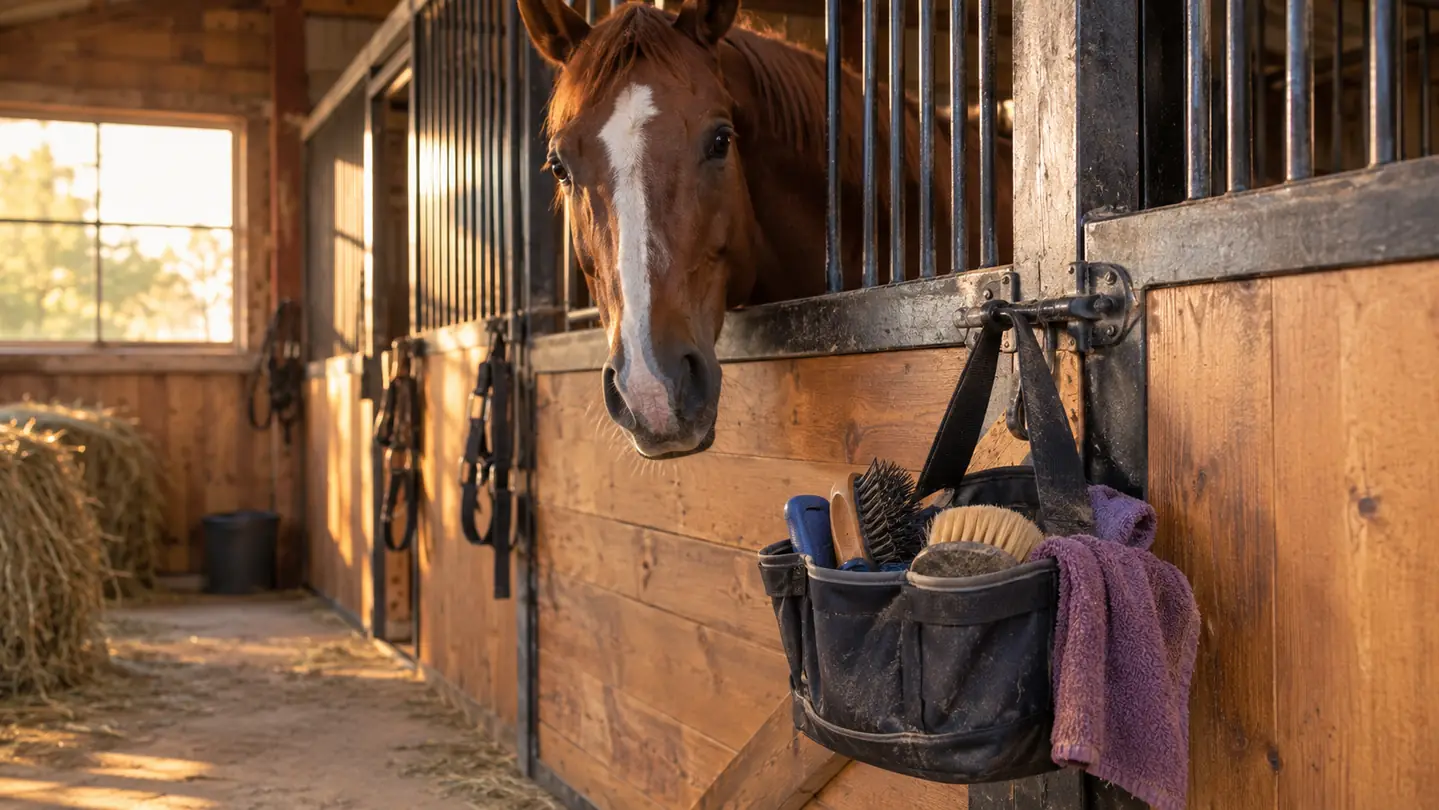
It has hung on the same stall door hook through mud season, hay season and one very wet October, and the webbing handles have not let go.
The Parts That Annoy Me
The plastic handles are my main complaint. In a wet winter, with soapy water in the bucket and mud on everything, a smooth plastic handle gets slippery in a way wood or rubber does not. I have dropped the curry more than once because of it. If you groom with gloves on this will bother you less, but bare-handed it is a genuine annoyance, and it is the one place the kit feels built to a price rather than built to last.
The comb is the other one. It is fine on a horse with a normal mane. It is not up to a thick, tangled tail in spring, when the winter coat is coming out and everything is matted and shedding at once. The tines bend before the knot gives. I finish with my fingers and then the comb, which works well enough, but I would not want to depend on this comb alone for a horse with a heavy tail.
I tried the obvious fix for the comb and it did not work. I sprayed a detangler on the worst of the tail knots and let it sit, then started at the bottom of the tail and worked up a few inches at a time, which is how you are supposed to do it. The tines still flexed before the knot gave. I ended up pulling the knots apart with my fingers and using the comb afterward just to lay the tail straight. That is a fine job for it. It is not a detangling tool and I stopped asking it to be one.
There is no divider inside the main compartment either, so the larger brushes end up in a pile together. Not a problem exactly, just a design choice I would have made differently. And the small face brush is stiff enough that I skip it around Dusty's ears and muzzle. He is thin-skinned there and he tells me so immediately. On the body it is fine.
How It Held Up Over a Year
A year in, here is the honest condition report. The tote has barn dust ground into the seams and one pocket sags a little from holding the hoof pick, but nothing has torn. The webbing handles are intact. The brushes have lost some of their stiffness, which is normal and honestly welcome on the soft one. The curry still has its teeth. The sweat scraper has a few scratches from the concrete and works exactly as it did on day one. The hoof pick has lost paint off the tip, and that is the only real cosmetic damage in the whole bag.
That is not bad for a set that gets used twice a day, every day, in a barn with a dirt floor and no climate control. I have replaced grooming tools every year or two for most of my life. This is the first set where I have not had to replace a single piece.
I keep a note on the tack room wall of when I buy things, mostly because I got tired of guessing how old a piece of equipment was. The kit went up on the stall door in late April. By the following April the only maintenance I had done was hosing the brushes off twice and wiping the tote down with a damp rag. No stitching has pulled and no handle has cracked. The plastic on the curry has a dull look to it now from sun and dust, and that is the whole of the wear. For a set that lives outdoors half the year, I will take it.
I also like that the kit does not come with a dozen extra items I would never touch. Seven is about right: enough to groom a horse nose to tail, not so many that half of them sit in the bottom of the bag going stiff. When I look in the bag now, everything in it gets used. That is rare enough to be worth saying out loud.
Who This Is For
This kit is for the person with one or two horses at home who grooms every day and is tired of hunting through a tub for a hoof pick. It is for the trail rider who throws the bag in the truck and needs it to survive the ride there. It is for the barn owner who wants one complete set a helper can grab without being told where anything is, because every tool in this kit has a pocket and there is only one place for it to go. If you groom a horse a day and you want a set that stays together, this does that job without fuss.
Who Should Skip It
Skip it if you show at a level where the finish on the coat matters, because this is a working kit and it will not give you a show shine. Skip it if you have a horse with a heavy, knot-prone tail and you expect the comb to do the work, because it will not. And skip it if you already own good brushes that fit your hand, because there is no sense replacing tools you like with tools you have to get used to. The brushes here are good. They are not personal, and a brush that fits the way you grip is worth more than a matching set.
One bag, every tool, hanging by the door where you can reach it
The Weaver Equine 7-Piece Grooming Kit has been on my stall door for a year. Six outer pockets, webbing handles, and a hoof pick you can actually find when you need it.
Amazon Check Today's Price on Amazon →