

Nobody warns you that buying a fly mask online is mostly guesswork. You get one photo of a horse standing in a pasture, a size chart that assumes every head was built on the same last, and a lot of hope. I have bought masks that slid down over Dusty's eyes before we reached the end of the driveway. I have bought masks so snug he rubbed the hair off his cheekbones in two days. So when I tell you what I think of the Harrison Howard CareMaster Pro, understand that it comes from a hay-covered place and not from a press release.
The short version: this is the mask that finally stayed put on my 14-year-old sorrel Quarter Horse gelding through a western New York summer of deer flies, black flies, and one long afternoon of burdock. It is not perfect. There are three things about it I would change tomorrow if I could, and I will get to all three. But after a full season of daily turnout and weekend trail rides, it has earned its hook in my tack room next to the halter. Here is the honest version, including the parts the listing photos never show you.
The Quick Verdict
Stays on through turnout, keeps the fine mesh clear of the lashes, and handles daily wear. Sizing runs generous and the ear tips are burdock magnets, so plan on adjusting it and picking it out.
Amazon Check Today's Price →The fly mask that made it through burdock season on a 15.1 hand gelding
Ultra-fine ventilating mesh, lab-tested UV protection, large eye space, ear covers, and touch-and-go closures that still grab after a summer outdoors. Full size, standard fit.
Amazon Check Today's Price on Amazon →What the Listing Photos Don't Show You
The listing leans hard on the eye space, and that is fair, because the eye space is the reason this mask works for Dusty. What the photos cannot show you is what a large eye opening feels like from the saddle. On a horse with a wide forehead, a small eye cut means the mesh sits right against the lashes, and every time the horse blinks, the mask nudges. By the second mile you have a horse tossing his head and you have a headache. The CareMaster Pro sits back off the eyes far enough that Dusty blinks without touching anything, and that alone changed how our July rides go.
The other thing the photos do not show is the mesh itself. It is ultra-fine, fine enough that when you hold it up to the sky you can barely see through it, and yet it ventilates. I have put my hand under it on a hot afternoon and felt air moving. Fine enough to stop the little flies, open enough that the horse is not cooking, and that combination is the whole trick with a fly mask. This one gets it right. The UV protection is lab-tested according to the listing, and while I cannot run that test myself, I can tell you the skin under the mask stayed pale and unburned through a summer that scorched my own neck.
Here is what the listing will not tell you, because no listing ever does. This is a mask for the eyes, the forehead and the ears. It is not a full face shield. Dusty's muzzle was still fair game for face flies all summer, and on the worst afternoons I still wiped his nose with a rag before I bridled him. If you are shopping for something that covers the whole face, keep shopping. If you want a mask that does one job well, read on.
I bought the Harrison Howard mask expecting to be disappointed, because I had been disappointed before. The first week I checked it every morning the way you check a new shoe for a hot spot. No rub at the poll. No rub at the cheek. No hair missing at the throatlatch. That is not a small thing. A mask that rubs is a mask that comes off, and a mask that comes off is money in the dirt.
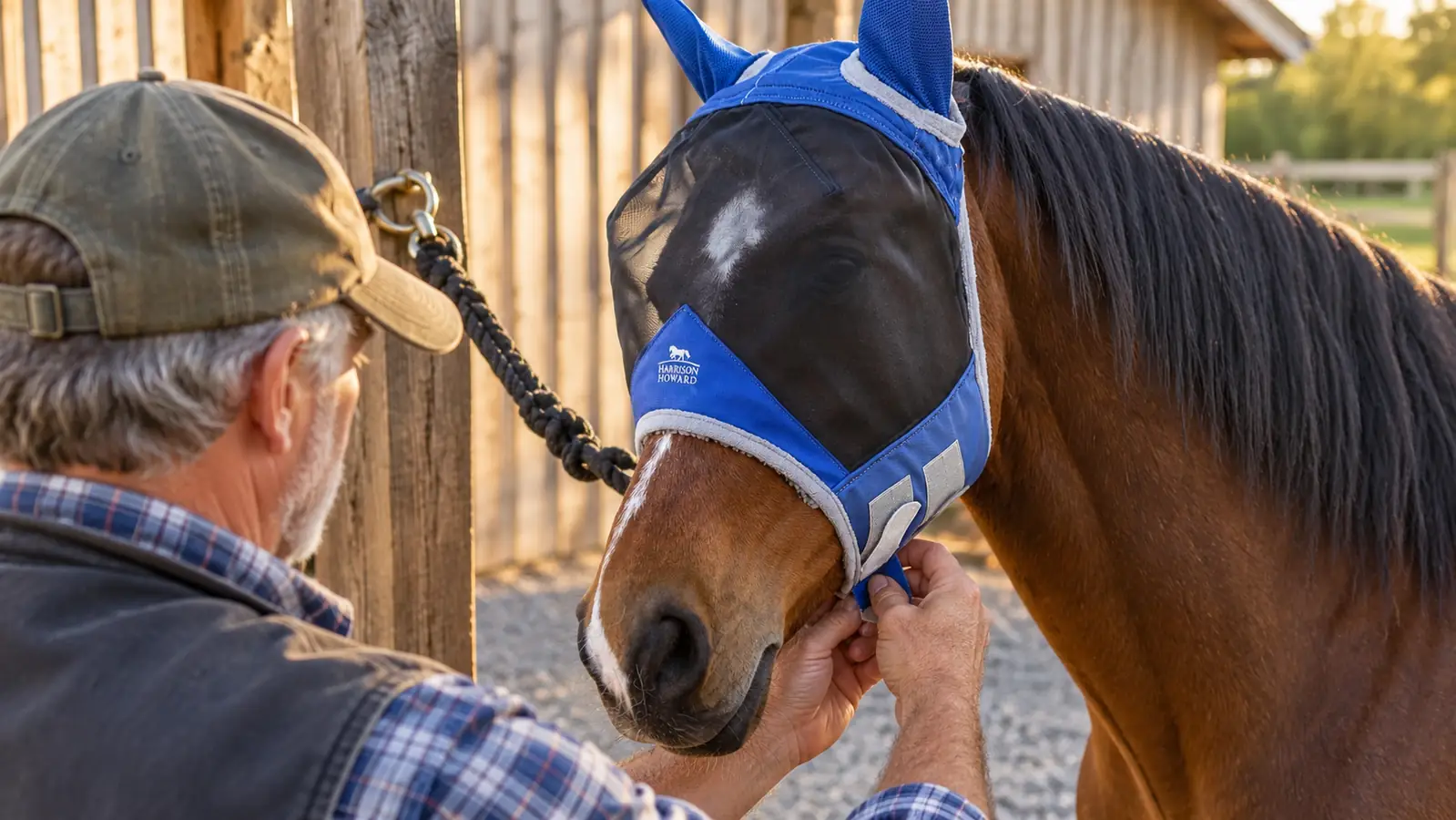
How the Mask Has Held Up in Daily Use
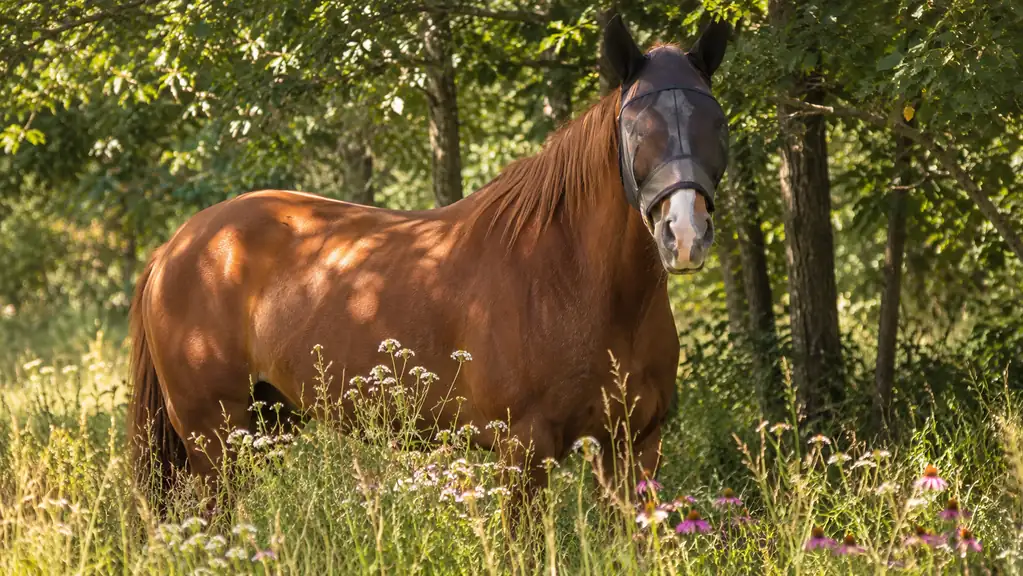
Dusty wears it from the time I turn him out after morning chores until I bring him in for the evening. That is roughly ten hours a day, five or six days a week, from late May into September. He is turned out on pasture with a run-in shed, a fence line he likes to lean on, and a burdock patch at the corner that I have been losing a fight against for four years. In other words, the CareMaster Pro has not lived a gentle life.
The mesh has held its shape. No runs, no pull lines, no sun-rotted thin spots. The touch-and-go closures still grab the way they did in June, which surprised me, because hook-and-loop is usually the first thing to go soft when it lives outdoors. I have rinsed the mask off with a hose maybe every ten days, hung it on the fence to dry, and put it back on. That is the entire maintenance routine. Nothing has needed mending.
The weak point, and I will say it plainly, is the ear tips. Burdock loves them. So does foxtail. If your pasture has any seed heads at all, you will be picking them out of the ear covers, and if you leave them, the burrs work their way into the seams. It is not a defect in the mask so much as a fact of biology, but it is work you should expect, and it is the main reason I do not rate this thing higher than I do.
We had a stretch in July with three days of rain. The mask got soaked through, dried on the fence overnight, and went back on without any stiffness or barn smell. Wet hook-and-loop is where cheap masks fall apart, and these closures came through it.
On trail days I pull the mask off at the hitching post and hang it on the trailer, then put it back on when we get home. It has ridden in the two-horse bumper-pull a dozen times without the mesh getting crushed under a saddle pad, which tells you something about how it packs.
One thing to know if your ground runs dry in August: the ultra-fine mesh will load up with dust, and a dusty mask cuts airflow. On the weeks when the pasture was powder, I rinsed it every few days instead of every ten days. It is a two minute job and it keeps the mask doing what it was made to do.
He leaned on the fence line with it more than once, and I found the mask hung up on a staple one morning, still on the horse. No tear, no stretched opening. I would not call it indestructible, because nothing made of mesh is, but it has taken the kind of abuse a pasture horse hands out.
The eye openings are the reason I bought it and the reason I would buy it again. Dusty can see the whole trail, and I am not fighting a mask that has slid down over his lashes by the second mile.
The Mesh, the Eye Space, and the Ears
Let me break down the three features that actually matter, because the listing names them and does not explain them. Start with the mesh. Ultra-fine means small holes. Small holes mean the little black flies that fit through a coarser mask cannot get in. It also means less airflow than a coarse mesh, which is why the ventilating part of the description matters. In practice, on a hot afternoon, Dusty sweated under the mask the same as he sweats without it, which is to say he sweated, because he is a horse and it was hot. He did not come in with the mask plastered to his face.
Next, the eye space. Large eye space is exactly what it sounds like: the openings are cut wide. On my gelding that means clearance. On a horse with a narrower face it may mean more gap than you need, and it may mean more room for a fly to sneak under the edge if the mask is not sitting level. That is the tradeoff nobody mentions. Wide eye openings protect the lashes and give the horse a clean field of view, but they only do that job if the mask is set so the openings sit where they are supposed to sit. Set it crooked and you have handed the flies a doorway.
Then the ears. The CareMaster Pro comes standard with ears, which I wanted, because the ears are where flies do the most damage on Dusty. Horseflies go for the inside of the ear and the horse cannot do much about it except shake his head until the halter rubs. The ear covers on this mask stay upright. They have not flopped down into his eyes, which was the failure mode on the mask I owned before this one. They do collect seed heads, as I said, but they do their job.
Fit, Sizing, and Staying Put
The size is listed as full, with a standard fit. What that means in practice is that it is built for an average horse head, and an average horse head is a thing that does not exist. Dusty is 15.1 hands with a Quarter Horse head, not especially wide and not especially narrow. The full size fits him with room to spare at the throatlatch and just enough at the poll. If your horse is between sizes, size down. If your horse carries a very wide forehead or a lot of jaw, this may be snug in a way that shows up as rubbing after a few days.
Getting it to stay on is mostly about the closures. The touch-and-go straps let you set the tension where you want it, and the mask stays where you set it. Here is the part I had to learn the hard way: snug is not optional. The first week I left the throatlatch a hole loose because I worried about rubbing, and Dusty had it off in the pasture twice. Once I set it properly he wore it all day without complaint. He is not a horse that rubs masks off for sport, but he will take advantage of a loose one.
One more fit note that nobody puts on a listing. Check the mask every morning for the first week. Not because the mask is faulty, but because horses change shape with the grass and the work. A mask that fit in May can sit differently by July. I tightened mine once in early July and once more in August, and after that it stayed right through the end of the season.
What I Liked
- Ultra-fine mesh keeps out the little flies a coarser mask lets through
- Large eye openings sit clear of the lashes on a wide forehead
- Ear covers stay upright instead of flopping into the eyes
- Touch-and-go closures still hold after a full season outdoors
- Rinses clean with a hose and has needed no mending
Where It Falls Short
- Sizing runs generous, so a horse between sizes will swim in the larger one
- Ear tips collect burdock and foxtail and need picking out
- No muzzle coverage, so face flies still get at the nose
- Wide eye openings only help if the mask is set level and snug
- Fine mesh holds dust on dry ground and wants a rinse
The Parts I Would Change
Three things. First, I would like the ear tips finished in a way that sheds seed heads, because the current ones grab them and hold on. Second, I would like a fit chart that talks about jaw width instead of just overall size, because the generous cut that suits my gelding will leave gaps on a finely built head. Third, I would like a card in the package about setting the closures snug, because what you get for instructions is about as thin as the mesh.
None of those are deal breakers. They are the kind of notes you would give a neighbor who asked how you liked the thing, which is what this review is. A woman down the road keeps a Paint mare with a much wider face, asked about the mask after seeing it on Dusty, and ordered one for herself. Hers fit with less room to spare, which tracks with everything I just said about sizing.
The honest scorecard on the Harrison Howard CareMaster Pro: it does three jobs well, meaning the mesh, the eye space and the ears. It does one job adequately, meaning staying on, and only if you set it right. It does not do a fourth job at all, meaning muzzle coverage. If you need that fourth job, no amount of adjusting will get you there.
Who This Is For
This is for the rider who wants one mask that covers the eyes and the ears, stays on through turnout, and does not need babysitting. It suits a horse with an average to slightly wide head, a horse that gets eaten alive around the eyes, and an owner who would rather rinse a mask with a hose than stitch one back together. If you ride trails in black fly country, this is the kind of gear that makes July bearable. The Harrison Howard CareMaster Pro has been exactly that for us, and I will hang it on the same hook next spring.
Who Should Skip It
Skip it if your horse needs muzzle coverage, because this mask stops at the eyes and the ears. Skip it if your horse is a genuine escape artist, because no fly mask wins that fight forever and this one is no different. Skip it if you have a very narrow, delicate head to fit, because the generous sizing will leave gaps you cannot adjust out. And skip it if you are not willing to check the fit for the first week, because a wide eye opening set crooked is worse than a small one set right.
One mask, one season, and the flies quit winning
Ultra-fine ventilating mesh with lab-tested UV protection, large eye space, ear covers, and touch-and-go closures. Set it snug the first week and check it every morning.
Amazon Check Today's Price on Amazon →