
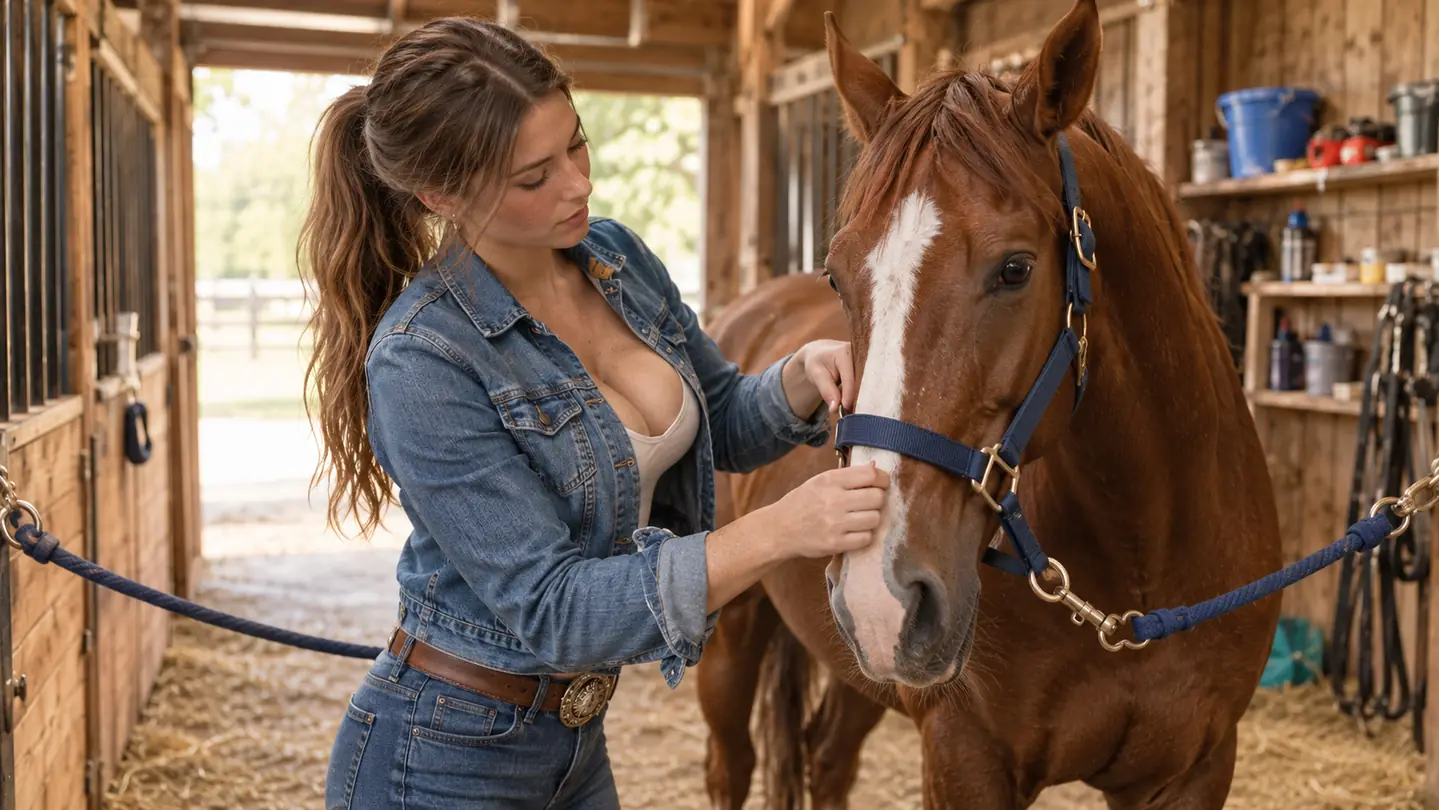
A halter that fits wrong does not announce itself. It waits. The horse lifts his head at the gate, the noseband slides up over the cheekbone, and now you are holding a lead rope attached to a horse you do not really have a hold on. I have had that happen in my own barn more than once, and it was never the horse's fault. It was mine.
Dusty is a 14-year-old sorrel Quarter Horse gelding, about 15.1 hands. He stands like a gentleman for the farrier and then tests every piece of equipment the second he decides the pasture looks better than whatever I had planned. A halter that creeps up on him does two bad things at once. It rubs the hair off his cheek, and it hands him an opening to pull back. So when I set up the Weaver Equine Nylon Horse Halter, I fitted it slowly instead of punching a hole wherever the tongue happened to land.
I have fitted a lot of halters badly over the years, and every one of those fits failed in the same three ways. Too loose at the nose. Crooked at the cheeks. Too tight at the throat. None of that was about the halter being poor quality. It was about me being in a hurry in a cold barn with a horse who wanted his hay. The ten minutes it takes to do this properly is the cheapest insurance you will ever buy for a horse that has to be caught, led, tied and loaded.
The Halter I Fit Once and Then Stopped Thinking About
The Weaver Equine Nylon Horse Halter in the one inch average horse size: padded PVC-coated foam rubber liner, brass plated hardware, snap closure, adjustable on both sides. Check today's price before you start measuring.
Amazon Check Today's Price on Amazon →How to Fit the Weaver Equine Halter, Step by Step
Step 1: Set the Noseband Height Before Anything Else
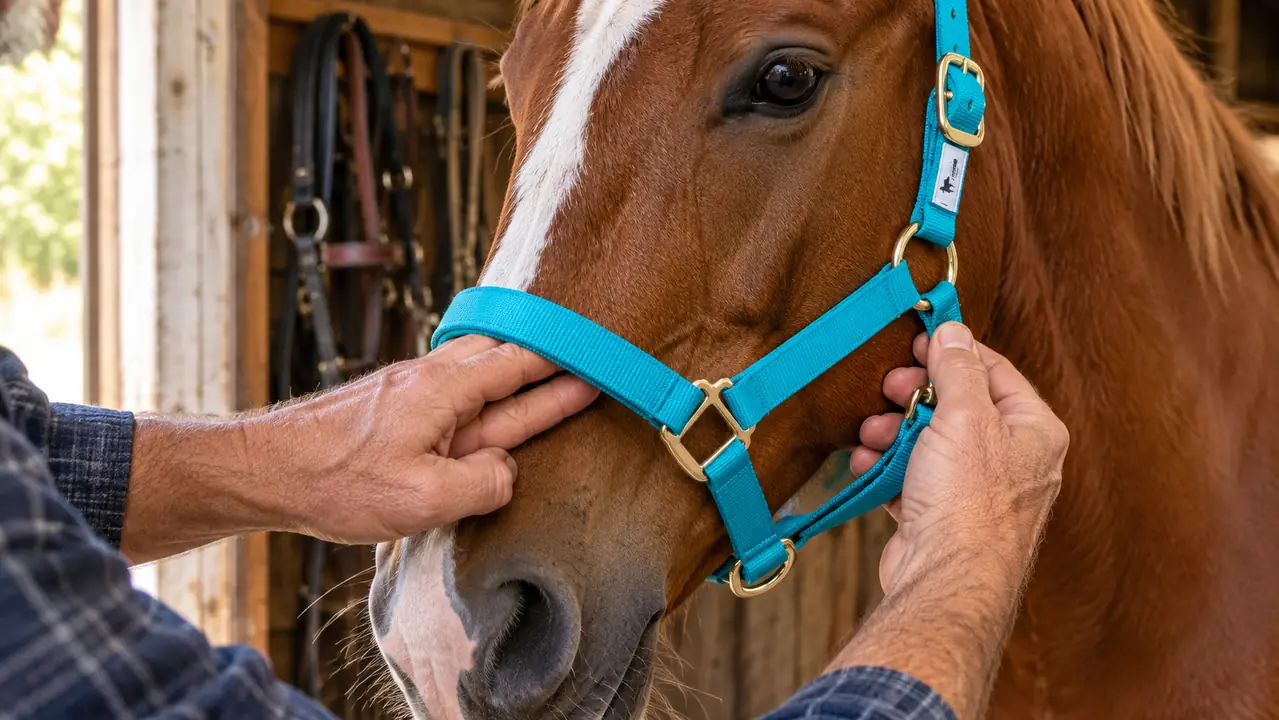
The noseband decides whether the halter stays put, so set it first and adjust everything else to match. On an average horse, the top edge of the noseband should sit about two fingers below the cheekbone, resting on the flat of the face, above the soft cartilage at the end of the muzzle. Too high and it rides up onto the cheekbone, where it rubs hair off and presses on tissue that has no padding to protect it. Too low and it sits on the soft part of the nose, and any horse that lifts his head will slide it up whether you like it or not.
The one inch webbing on this halter is wide enough that you can feel where the noseband is sitting without crouching down to look. I slide two fingers under it at the side of the face, then check the same spot on the other side. The fit is right when the noseband does not move when I gently rock it, and does not press the skin into a ridge when I let go. If the skin bunches up under it, the noseband is sitting too low or too tight, and no amount of fiddling with the throat strap will fix that.
Step 2: Bring the Cheek Straps and Crownpiece Into Line
The crownpiece sits over the poll behind the ears, and the cheek straps set the height of the noseband, so this step is really about making the first step stay done. Set the crown so it rests behind the ears without pressing on the base of them, and without sitting so far forward that it wants to slide back toward the withers. Then shorten or lengthen the cheek straps until the side rings sit level with the cheekbone on both sides.
This is where most halters end up crooked. People adjust one side, check the near side in the barn light, and never walk around to the off side. I adjust a little at a time, alternating sides, until the rings are at the same height. The Weaver Equine halter adjusts on both sides, so there is no reason for one cheek strap to be three holes shorter than the other. If the rings are level and the noseband sits where it should, the rest of the fit is easy.
Step 3: Set the Throat Snap With the Head Down
The throat piece is the part people get wrong by testing it in the wrong position. With the horse's head up at your chest, almost any throat setting feels fine. Ask him to drop his head as if he were about to graze, then check it. You want to be able to slide a flat hand under the throat strap. If it is snug enough that it presses when his head is down, it will press on his windpipe every time he grazes or drinks, and he will let you know about it in his own way.
This halter closes with a snap, which is the reason the throat setting is worth getting exactly right once. Set it, then the halter comes off and goes on with the snap and nothing else moves. I set the throat length, snap and unsnap it a few times to make sure the webbing has not crept, and then I leave it alone. If you find yourself lengthening the throat strap a week later, go back and check whether the noseband came up with it, because that usually means a cheek strap slipped.
One more thing about the snap. If your horse is the type to rub his head on a fence post or a gate rail, check the snap after he does it. I give mine a tug every time I put the halter on, which takes one second and has caught a bent snap once. That is not a fitting problem, but it is the same ten minutes of attention, and it is worth it.
Two fingers between the cheekbone and the top edge of the noseband. If you cannot fit two, it is too high. If you can fit four, it is too low, and it will slide up the moment he lifts his head.
Step 4: Check the Padding and Hardware From Both Sides
The PVC-coated foam rubber liner on this halter is there to spread pressure over the nose and poll instead of letting one inch of webbing dig in. That only works if the padding lies flat. Run a hand under the noseband and under the crownpiece and feel for folds, gaps, or a liner that has rolled. Any of those will turn into a rub, and a rub on the nose is slow to heal because the halter sits on it every single day.
Then look at the hardware. The brass plated rings and the snap should sit clear of bone, not resting on the cheekbone or the point of the jaw. Walk around to the off side and check the whole thing again from that angle, because a halter that looks straight from one side can be sitting a hand's width off from the other. If a ring is pressing, the cheek strap on that side needs to come down a hole. If the padding is bunched at the poll, the crown is too short.
Step 5: Test It Under Hand, Then Check Again in a Week
A fit that passes in the aisle still has to survive a horse. I lead at a walk and a trot, ask for a turn each way, and ask him to lower his head. Then I tie with a quick-release knot at about chest height, to something solid that will not move, for a few minutes while I watch. I check the noseband, the poll and behind the ears at the ten minute mark, looking for hair rubbed the wrong way or skin that has gone pink.
The second check matters just as much and most people never do it. A week of daily use tells you things ten minutes cannot. New nylon softens and settles, the padding compresses a little, and a strap that was right on day one can be a hole loose by day seven. I run the two finger check again after a week, then again at the end of the first month, and after that it holds.
If the fit does change, work backwards through the steps instead of tightening something at random. Nine times out of ten the noseband moved because a cheek strap slipped or the crown settled differently after the padding compressed. Fixing the cause takes a minute. Chasing the symptom takes a week of fiddling and gives you a horse that gets sour about having his head handled.
Sizing Notes on the One Inch Average Horse Halter
Weaver Equine lists this one as the one inch average horse size, in the range of Quarter Horse, Thoroughbred and Warmblood heads. Dusty at 15.1 hands lands squarely in that range, and the halter fits him with adjustment left over on both the crown and the cheek straps, which is what you want. Laid flat it measures 20 by 12.5 by 2 inches and weighs 1.26 pounds, and that weight is most of the reason it feels as substantial in the hand as it does.
The one inch width is worth thinking about if your horse leans or pulls. A wider noseband spreads the same pull over more of the face, and with the foam liner under it, that is easier on a horse than a narrow strap digging in. On a very fine headed horse, the same width can look and feel like a lot of halter, and that is a real trade off rather than something to talk around. On an average head it is not a problem. On a delicate one, look at it in person before you commit.

Common Mistakes That Undo a Good Fit
The mistake I see most is a halter that is a size too big, then over tightened at the throat to compensate. If the noseband sits too low and the throat strap gets cranked up to stop the halter sliding forward, you have a horse that is uncomfortable at the throat and still loose where it counts. Go back to the cheek straps. No amount of tightening at the throat will substitute for a noseband at the right height.
The second is checking the fit once and never again. Halters stretch, padding compresses, and horses change shape with age and work. Dusty is 14 and his head has not changed in years, but the halter still gets the two finger check every couple of months, because the alternative is finding out at the hitching post with a horse already half turned around. The third is leaving a halter on a horse turned out in a group. That one is not a fitting mistake exactly, but it is the one that puts a horse in the vet's barn, so I will keep saying it.
What Else Helps
A halter is only half of the setup. The lead rope and its snap matter too, and a heavy snap on a light halter is exactly what pulls a noseband out of place. I like a lead with a solid but not oversized snap, and I check that snap every few weeks, because a worn snap is the cheapest failure to prevent and the most expensive one to have happen out on a road.
Beyond the hardware, the fit holds better when the horse understands pressure. A horse that has been taught to give to a lead rope will not lean on a halter, and a halter that is not being leaned on stays where you set it. It is also worth checking the halter after every turnout if your horse wears one in the pasture, and taking it off entirely for a horse turned out with company. Halters catch on things. That is not a fit problem you can solve with a strap.
Ten Minutes Now, or a Loose Halter at the Worst Moment
Same halter, one inch average horse size, padded with a PVC-coated foam rubber liner, adjustable on both sides, and a snap closure that means you set the throat once and forget it. Check today's price on Amazon and fit it before the next trail ride.
Amazon Check Today's Price on Amazon →